
Civil penalties for speed violations on Colorado Highway 119 to begin Jan. 12
Travel Advisory
Statewide — Starting Monday, Jan. 12, the Colorado Department of Transportation’s Colorado Speed Enforcement Program will start issuing $75 civil penalties to drivers exceeding the speed limit by 10+ MPH in the CO 119 Safety, Mobility & Bikeway Project work zone in Boulder County. The move marks the next phase of the safety program, designed to curb excessive speed, which is the leading contributor to traffic crashes and fatalities in Colorado. Warnings in the corridor will remain active until civil penalties begin.
The transition from warnings to civil penalties follows a required 30-day warning period. The warning period on CO 119 has been active since July 2025, providing motorists plenty of time to adjust to the new program. Once civil penalties begin, any violation captured by automated cameras will result in a mailed notice of violation to the registered owner of the vehicle, who is legally responsible for the penalty regardless of who was driving. Recipients have 45 days to pay or dispute the violation by visiting coloradospeedenforcement.com. Failure to take action may result in a Notice of Civil Penalty Assessment, Hearing Officer Final Order, and possible collection action, as provided by law.
“Average speeds starkly decreasing on CO 119 means the Colorado Speed Enforcement Program is already doing its job to increase safety in the corridor,” said CDOT Chief Engineer Keith Stefanik. “Civil penalties are meant to curb the behavior of speeding drivers, not punish them. By moderating speed, we can save lives — plain and simple.”
Preliminary data shows the program is achieving its intended results even before penalties begin. Since the program began, high speeds have dropped more than 80% in the CO 119 work zone. Average speeds along the Diagonal Highway now sit between 53 to 56 MPH. In the first month of the program, average speeds dropped by an average of 8 MPH, demonstrating how automated enforcement can change dangerous driving behavior.
During 2025, data shows that work zone crashes in Colorado caused 532 injuries, a nearly 12% decrease from 2024 (602). Additionally, there have been eight work zone fatalities so far in 2025, marking a 73% decrease since last year (30). While this data is promising, there is still work to be done on our most vulnerable roads, CDOT says. Since 2015, there have been 129 work zone-related crash fatalities in the state.
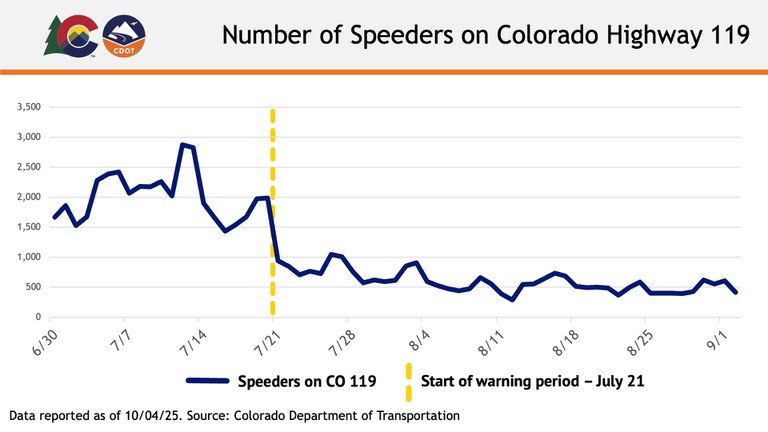
As of Dec. 8, CDOT has issued 34,050 warning notices to first-time violators on CO 119 during the warning phase. These notices carried no monetary penalty and served solely to alert drivers to the new enforcement zone.
Nationwide research has demonstrated that automated enforcement programs effectively combat high speeds among drivers. According to the Federal Highway Administration, point-to-point speed cameras reduce roadway injuries and fatalities by 20% to 37%. Several polls have also shown that there is often broad public support for the use of camera technology as a means of neutral, consistent enforcement.
Stopping distance, which is the distance between the moment a driver perceives a hazard to the point where the vehicle achieves a complete stop, increases exponentially with speed. According to the National Highway Traffic Safety Administration (NHTSA), stopping distance quadruples when speed doubles. At 60 MPH, approximate stopping distance is 345 feet, over 36% longer than the distance required at 50 MPH (240 feet), per the American Association of State Highway and Transportation Officials (AASHTO). When drivers must navigate a work zone with shifting lanes, sharp curves and unpredictable obstacles, that distance could mean the difference between a close call and a tragedy.
Enforcement sites are selected based on considerations of crash and speed data indicating high-risk corridors, and the viability of in-person law enforcement. CDOT selected CO 119 as the first corridor to launch the program based on a variety of factors related to safety during the construction of the Safety, Mobility & Bikeway project. With traffic expected to increase on the corridor, the project will make necessary improvements to the roadway alongside multimodal integrations, including bus rapid transit and a continuous bike path. Construction began in September 2024 and is expected to conclude in 2027.
About the Colorado Speed Enforcement Program
In 2024, speeding was the most common cause of fatal crashes in Colorado. The dangers of speeding are especially high in work zones, where challenging conditions and vulnerable roadside workers create hazardous circumstances. The Colorado Department of Transportation’s Colorado Speed Enforcement Program aims to reduce speed-related crashes and fatalities on Colorado roads and improve safety for drivers, road workers, vulnerable road users and law enforcement. Using Automated Vehicle Identification Systems (AVIS) in high-risk, CDOT-owned corridors, cameras identify vehicles traveling an average of 10 MPH or more over the posted speed limit and automatically issue $75 civil penalties to the registered owner of the vehicle. The program will start first on CO 119 and is expected to expand into school zones and other high-risk corridors in the future. More information about the Colorado Speed Enforcement Program can be found at codot.gov/programs/speedenforcement.
Remember: Slow For The Cone Zone
The following tips are to help you stay safe while traveling through maintenance and construction work zones.
- Do not speed in work zones. Obey the posted speed limits.
- Stay Alert! Expect the unexpected.
- Watch for workers. Drive with caution.
- Don't change lanes unnecessarily.
- Avoid using mobile devices such as phones while driving in work zones.
- Turn on headlights so that workers and other drivers can see you.
- Be especially alert at night while driving in work zones.
- Expect delays, especially during peak travel times.
- Allow ample space between you and the car in front of you.
- Anticipate lane shifts and merge when directed to do so.
- Be patient!
Download the COtrip App!
The new free COtrip Planner mobile app was designed to meet the growing trend of information on mobile and tablet devices for the traveling public. The COtrip Planner app provides statewide, real-time traffic information, and works on mobile devices that operate on the iOS and Android platforms. Visit the Google Play Store (Android devices) or the Apple Store (iOS devices) to download!
