
Motorists be prepared - winter isn’t over yet
Travel Advisory
Statewide — Following treacherous winter weather on April 14 and related crashes statewide, the Colorado Department of Transportation is issuing a reminder to all motorists: Winter is not over.
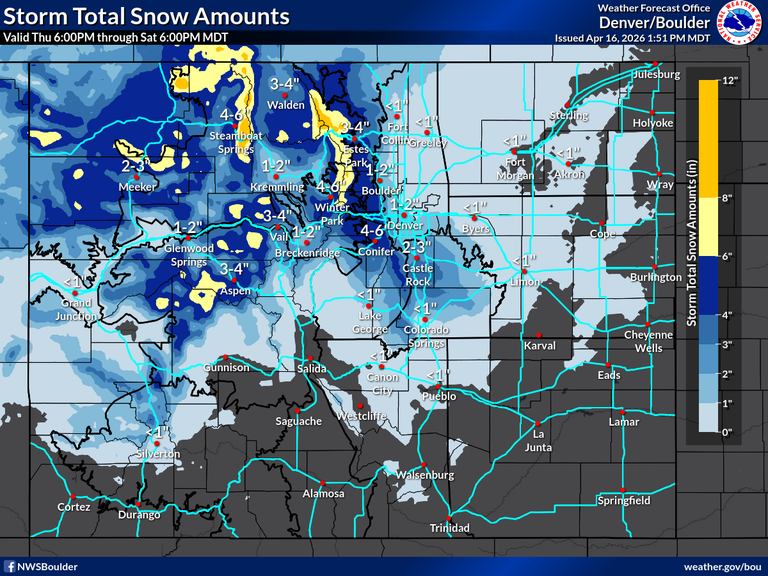
Despite an unseasonably dry year, a fast-moving system will race across the state tonight, Thursday, April 16, though tomorrow morning, Friday, April 17. While pavement conditions are expected to improve during the day on Friday, a hard freeze Friday night could be a hazard for some areas, but parts of Colorado will also see accumulating snow - mainly at higher elevations.
Snowstorms can still occur throughout the remainder of spring and CDOT officials emphasize that compliance with state Traction and Chain Laws is a matter of public safety, not a suggestion. In addition, posted speed limits apply only to ideal conditions—if the weather changes, so should your speed. CDOT reminds drivers to slow down and give others plenty of space during spring storms.
"Tuesday’s crashes are a sobering example of how quickly conditions deteriorate when drivers are unprepared for Colorado’s unpredictable winter weather," said CDOT Executive Director Shoshana Lew. "We are seeing a dangerous trend of motorists neglecting safety protocols. The reality is that mountain passes and the Interstate 70 Mountain Corridor can transition from dry pavement to ice in minutes."
Chain and Traction Laws in effect yearly from Sept. 1 to May 31
- Traction Law: During winter storms, or when conditions require, CDOT will implement the Passenger Vehicle Traction (PVT) law. CDOT can implement traction and chain laws on any state highway. During a traction law, all motorists are required to have:
- All-wheel drive (AWD)/four-wheel drive (4WD) vehicles with tires designated as mud and snow (mountain-snowflake icon or M+S or M/S denoted) and 3/16-inch tread depth, or
- AWD/4WD vehicles with winter tires (mountain-snowflake icon or M+S or M/S denoted) and 3/16-inch tread depth, or
- AWD/4WD vehicles with an all-weather rating by the manufacturer and 3/16-inch tread depth, or
- Chains or an approved alternative traction device
- Commercial Motor Vehicle Chain Law: All heavy-duty vehicles are required to carry chains or alternative traction devices and must be prepared to deploy them immediately when signaled by highway on In-Cab alerts.
Drivers are encouraged to check COtrip.org or the COtrip Planner App for real-time road conditions and to ensure their vehicles are winter-ready before heading into the high country.
Know Before You Go
Travelers are urged to “know before you go.” Gather information about weather forecasts and anticipated travel impacts and current road conditions prior to hitting the road. CDOT resources include:
- Road conditions and travel information: COtrip.org
- Download the COtrip Planner app: bit.ly/COtripapp
- Sign up for project or travel alerts: bit.ly/COnewsalerts
- Check scheduled construction lane closures: bit.ly/laneclosures
- Connect with @ColoradoDOT on social media: X, Facebook, Instagram and YouTube
Remember: Slow For The Cone Zone
The following tips are to help you stay safe while traveling through maintenance and construction work zones.
- Do not speed in work zones. Obey the posted speed limits.
- Stay Alert! Expect the unexpected.
- Watch for workers. Drive with caution.
- Don't change lanes unnecessarily.
- Avoid using mobile devices such as phones while driving in work zones.
- Turn on headlights so that workers and other drivers can see you.
- Be especially alert at night while driving in work zones.
- Expect delays, especially during peak travel times.
- Allow ample space between you and the car in front of you.
- Anticipate lane shifts and merge when directed to do so.
- Be patient!
Download the COtrip App!
The new free COtrip Planner mobile app was designed to meet the growing trend of information on mobile and tablet devices for the traveling public. The COtrip Planner app provides statewide, real-time traffic information, and works on mobile devices that operate on the iOS and Android platforms. Visit the Google Play Store (Android devices) or the Apple Store (iOS devices) to download!
