
Civil penalties for speed violations on Colorado Highway 119 begin today
Travel Advisory
Statewide — Starting today, the Colorado Department of Transportation’s Colorado Speed Enforcement Program will begin issuing $75 civil penalties to drivers exceeding the speed limit by 10+ MPH in the CO 119 Safety, Mobility & Bikeway Project work zone in Boulder County. The shift in enforcement comes as speeding remains the top contributor to fatal crashes in Colorado. The program aims to address this alarming fact by decreasing excessive speeds and increasing safety in high-risk corridors, starting with work zones.
Before the launch of the Colorado Speed Enforcement Program on Colorado Highway 119, 15% of motorists exceeded speeds of 64 MPH, where the posted work zone speed limit is 55 MPH. Since the start of the warning period, which began in July 2025, speeding in the corridor has decreased by an average of 8 MPH. The warning period is officially over, and drivers in violation of the program will now face civil penalties.
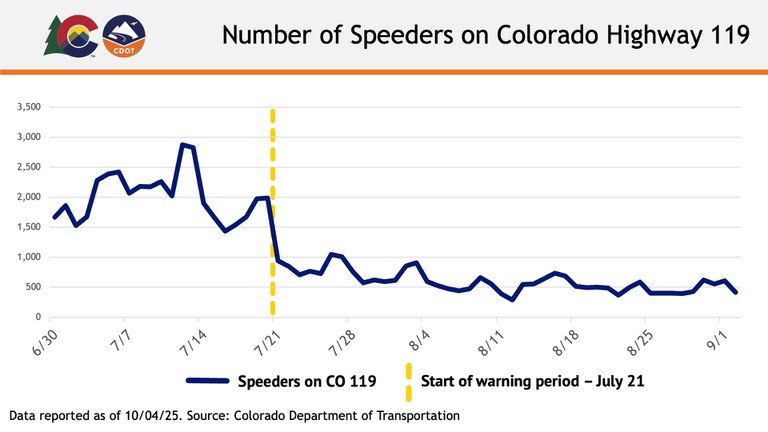
“Our primary goal is safety on our roadways, and addressing excessive speeds on our most vulnerable corridors is necessary,” said CDOT’s Chief Engineer Keith Stefanik. “The Colorado Speed Enforcement Program is intended to serve as a reminder to drivers of our shared vision of a future without serious traffic injuries or fatalities and the safety measures taken to make that vision a reality.”
Civil penalties are mailed to the registered owner of the vehicle. If a civil penalty is not paid or the violation is not disputed within 45 days of the original Notice of Violation, the recipient will be issued a Notice of Civil Penalty Assessment, which must be paid within 30 days of the date issued. If the penalty is not paid, an administrative Hearing Officer will review the evidence and enter a final order determining liability. Excess revenue collected by the program is distributed to a Vulnerable Road Users Fund to help pay for critical safety infrastructure. Keep in mind that CDOT never uses text messaging to collect any payments or personal information from customers. If you receive a text message asking for payment of a toll or speeding violation in Colorado, it is a scam.

The program uses camera technology, known as an Automated Vehicle Identification System (AVIS), to track speeds. Drivers exceeding the speed limit by 10+ MPH will receive a Notice of Violation. If no violation is recorded, photos taken by AVIS are immediately deleted, as required by law. The presence of speed cameras is clearly marked by signage at least 300 feet in advance, and their exact locations by Mile Point are published on CDOT’s program webpage at codot.gov/programs/speedenforcement.
In 2024, work zone-related crash fatalities hit a record high, totaling 30 lives lost. Preliminary data shows that there were nine work zone fatalities in 2025, marking a 70% decrease since 2024 (30). Additionally, work zone crashes in Colorado caused 554 injuries in 2025, a nearly 8% decrease from 2024 (602). Nationwide, speed cameras have proven to be an effective combatant to excessive speeds, lowering the risk of fatality by up to 37%, according to the Federal Highway Administration. Research has shown that the use of automated speed enforcement is broadly supported by the public as a means of neutral, consistent enforcement, and preliminary data shows CDOT’s program is already achieving its intended results.
CO 119 is currently undergoing construction related to the Bikeway, Safety and Mobility project, which includes roadway improvements and multimodal integrations like bus rapid transit and a continuous bike path. Construction began in September 2024 and is expected to conclude in 2027. The launch of the program in another work zone, school zone or high-risk corridor would begin with a warning period of at least 30 days. No additional corridors have been announced at this time.
About the Colorado Speed Enforcement Program
In 2024, speeding was the most common cause of fatal crashes in Colorado. The dangers of speeding are especially high in work zones, where challenging conditions and vulnerable roadside workers create hazardous circumstances. The Colorado Department of Transportation’s Colorado Speed Enforcement Program aims to reduce speed-related crashes and fatalities on Colorado roads and improve safety for drivers, road workers, vulnerable road users and law enforcement. Using Automated Vehicle Identification Systems (AVIS) in high-risk, CDOT-owned corridors, cameras identify vehicles traveling an average of 10 MPH or more over the posted speed limit and automatically issue $75 civil penalties to the registered owner of the vehicle. The program will start first on CO 119 and is expected to expand into school zones and other high-risk corridors in the future. More information about the Colorado Speed Enforcement Program can be found at codot.gov/programs/speedenforcement.
Know Before You Go
Travelers are urged to “know before you go.” Gather information about weather forecasts and anticipated travel impacts and current road conditions prior to hitting the road. CDOT resources include:
- Road conditions and travel information: COtrip.org
- Download the COtrip Planner app: bit.ly/COtripapp
- Sign up for project or travel alerts: bit.ly/COnewsalerts
- Check scheduled construction lane closures: bit.ly/laneclosures
- Connect with @ColoradoDOT on social media: X, Facebook, Instagram and YouTube
Remember: Slow For The Cone Zone
The following tips are to help you stay safe while traveling through maintenance and construction work zones.
- Do not speed in work zones. Obey the posted speed limits.
- Stay Alert! Expect the unexpected.
- Watch for workers. Drive with caution.
- Don't change lanes unnecessarily.
- Avoid using mobile devices such as phones while driving in work zones.
- Turn on headlights so that workers and other drivers can see you.
- Be especially alert at night while driving in work zones.
- Expect delays, especially during peak travel times.
- Allow ample space between you and the car in front of you.
- Anticipate lane shifts and merge when directed to do so.
- Be patient!
Download the COtrip App!
The new free COtrip Planner mobile app was designed to meet the growing trend of information on mobile and tablet devices for the traveling public. The COtrip Planner app provides statewide, real-time traffic information, and works on mobile devices that operate on the iOS and Android platforms. Visit the Google Play Store (Android devices) or the Apple Store (iOS devices) to download!
