CDOT proposes to accelerate sidewalk and intersection improvements for Colorado Boulevard
News Release
Denver — The Colorado Department of Transportation seeks the public’s feedback on a revised approach to improving Colorado Boulevard that focuses on pursuing targeted intersection, sidewalk and multimodal improvements, and “quick wins” like improving bus shelters that can enhance quality of life on the corridor in the near term. These types of improvements will advance key safety goals, especially for vulnerable road users—a priority strengthened in 2024 by the legislature through SB 24-195, Protect Vulnerable Road Users.
Studies including CDOT’s 2024 Colorado Boulevard Corridor Plan showed a number of challenges to multimodal safety and quality of life along the corridor and emphasize the need to make these kinds of improvements as soon as possible. The studies also show that analysis of additional Bus Rapid Transit (BRT) features would benefit from further study that incorporates performance data from other BRT corridors, including Colfax Avenue and elsewhere. CDOT expects to initiate that additional review in 2028.
Imagining a Connected Colorado Boulevard
From its construction in the 1880s through the early 20th century, Colorado Boulevard was a walkable street with sidewalks and many kinds of users. It shifted away from that in the early 20th century, and evolved into a road that is difficult to traverse — especially for vulnerable road users traveling outside of a car. Significant portions of the sidewalk are narrow and precarious. Crossing high volume stretches of the roadway is difficult and creates barriers to accessing neighborhoods and businesses.
Fixing these deficiencies will connect neighborhoods, improve safety, accessibility to transit, benefit businesses, and improve quality of life. However, each section of improvement is a significant undertaking that requires prioritization, planning, design, and funding.
Connecting Neighborhoods by Making it Safer to Cross the Street
Colorado Boulevard is a big, busy street that is in many places daunting and unsafe to cross. Intersection improvements can deliver immediate benefits for pedestrians, especially wheelchair and stroller users. Safety upgrades at these locations would help reduce severe crashes and make transit more accessible, both now and in the future.
CDOT’s 2024 Colorado Boulevard Corridor Plan identified some of the intersections most in need of an upgrade, drawing upon the Denver Colorado Boulevard. Corridor Plan, crash analysis and bike and pedestrian analysis, as well as feedback. Intersections identified for needed improvements include:
- Bruce Randolph Ave.
- 6th and 7th Aves.
- Mississippi Ave.
- 1st Ave.
- Florida Ave.
- 35th Ave.
Fixing sidewalk gaps for all users of Colorado Boulevard
The study also identified specific areas of the sidewalk along Colorado Boulevard that do not comply with the Americans with Disabilities Act (ADA), and create a poor pedestrian experience in their present state, which presents a major barrier to accessing and using public transit.
Examples of these deficient stretches include:
- Between East Martin Luther King Junior Boulevard and East 26th Avenue along Colorado Boulevard
- Between 6th Avenue and Bayaud Avenue along Colorado Boulevard
- Between Warren Avenue and Wesley Avenue (east side of Colorado Boulevard)
The image below shows all identified sidewalk gaps along Colorado Boulevard.
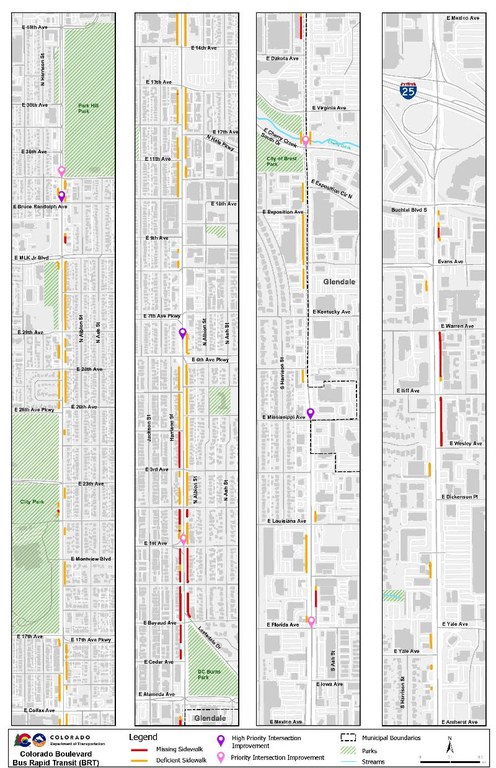
Improving problem intersections and stretches of poor sidewalk can deliver improvements to neighborhoods through the area.
Collaboration with the City and County of Denver to make the street work more efficiently
Like many of the busiest roads in the state’s urban network, Colorado Boulevard intersects city streets, and hosts shared assets. The state’s approach includes an active collaboration with the City and County of Denver on multiple aspects of operational improvement. Part of the phased improvements will also include opportunities for signal timing and transit prioritization enhancements to facilitate more reliable and efficient bus service.
Incremental approach to funding, design, and delivery
At present, Colorado Boulevard has been prioritized to receive $21 million in funding from CDOT’s 10-Year Plan. These funds are budgeted to begin in FY 2031, though CDOT will seek to apply for other grant funds ahead of that timeline as designs for discrete elements become ready to compete. Currently anticipated dollars will be insufficient to fix all of the safety and quality of life improvements identified above, so prioritizing these incremental improvements and moving them towards design will be critical. CDOT also intends to request that the City and County of Denver’s Sidewalk Enterprise Fund prioritize Colorado Boulevard. The incremental delivery of these projects also limits work zone constraints on a busy road at any given time.
CDOT plans to start pursuing the fixes described above now, well ahead of any design or funding decisions regarding any changes to lane configuration to support future Bus Rapid Transit for the corridor. CDOT plans to begin a reassessment of future BRT options in 2028, allowing the study to incorporate a wide range of data, including the initial performance of Colfax BRT, which will have several years of initial operations data to draw from by that point in time. Notably, initial study was sufficient to conclude that a center running bus configuration is not appropriate for this road; that will be removed from consideration in future review.
Seeking public input
As CDOT pursues the next steps to advance its phased approach to Colorado Boulevard improvements, members of the public are invited to share their thoughts to help prioritize project elements.
In particular, CDOT seeks public input on which road crossings and sidewalk stretches should be prioritized first, as part of an incremental approach.
Comments may be submitted online here: Colorado Boulevard Sidewalk & Intersection Improvements Comments.
Know Before You Go
Travelers are urged to “know before you go.” Gather information about weather forecasts and anticipated travel impacts and current road conditions prior to hitting the road. CDOT resources include:
- Road conditions and travel information: COtrip.org
- Download the COtrip Planner app: bit.ly/COtripapp
- Sign up for project or travel alerts: bit.ly/COnewsalerts
- Check scheduled construction lane closures: bit.ly/laneclosures
- Connect with @ColoradoDOT on social media: X, Facebook, Instagram and YouTube
Remember: Slow For The Cone Zone
The following tips are to help you stay safe while traveling through maintenance and construction work zones.
- Do not speed in work zones. Obey the posted speed limits.
- Stay Alert! Expect the unexpected.
- Watch for workers. Drive with caution.
- Don't change lanes unnecessarily.
- Avoid using mobile devices such as phones while driving in work zones.
- Turn on headlights so that workers and other drivers can see you.
- Be especially alert at night while driving in work zones.
- Expect delays, especially during peak travel times.
- Allow ample space between you and the car in front of you.
- Anticipate lane shifts and merge when directed to do so.
- Be patient!
Download the COtrip App!
The new free COtrip Planner mobile app was designed to meet the growing trend of information on mobile and tablet devices for the traveling public. The COtrip Planner app provides statewide, real-time traffic information, and works on mobile devices that operate on the iOS and Android platforms. Visit the Google Play Store (Android devices) or the Apple Store (iOS devices) to download!
