
Sun glare safety detours return to eastbound I-70 at Floyd Hill
Travel Advisory
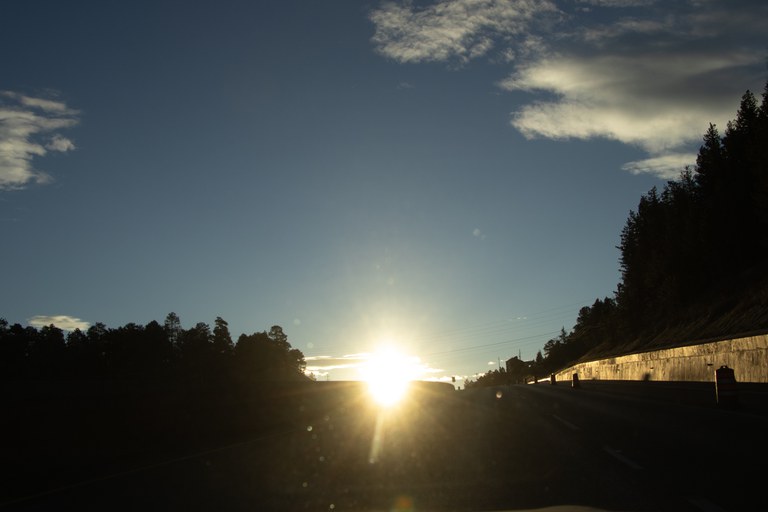
I-70 Mountain Corridor – Sun glare season will return to the I-70 Mountain Corridor. Bright mornings may require eastbound Interstate 70 detours at Floyd Hill (approximately Mile Points 244 to 248 – east of Idaho Springs) from sunrise to 8:30 a.m. from early November through February. Formerly referred to as a sun glare closure, a sun glare detour does not stop traffic, but reroutes vehicles off eastbound I-70 at the bottom of Floyd Hill, where motorists can continue east on US 6 through Clear Creek Canyon or take the eastbound frontage road (US 40) to re-enter I-70 at Beaver Brook (Exit 248). When detours occur, drivers traveling on eastbound I-70 should prepare for delays of up to an hour.
A preparatory traffic hold will occur at approximately 7 a.m. on Wednesday, Oct.21, in advance of the seasonal detours beginning Nov. 1.
Why the Detours are Necessary
Sun glare safety detours at Floyd Hill protect the traveling public. Detour decisions are made daily, on a case-by-case basis, through coordination between Colorado State Patrol (CSP) and CDOT personnel stationed near Floyd Hill.
The low eastward sun angle can create blinding glare for drivers, particularly when combined with conditions unique to the mountain corridor, including:
- Roadway moisture: Rain, melting snow, or liquid pre-treatment materials significantly amplify glare.
- Challenging terrain: Steep grades and sharp turns reduce visibility and stopping sight distance.
- Unforeseen hazards: Sudden obstacles, such as wildlife crossing the highway.
For these reasons, CSP and CDOT work together to implement sun glare safety detours to keep motorists as safe as possible when conditions create an unsafe driving environment.
About Sun Glare Detour
In the 1990s, before standardized protocols existed, Colorado State Patrol troopers stationed near Floyd Hill manually held or slowed traffic when blinding glare caused a spike in morning crashes. By the early 2000s, rising commuter and freight traffic through the I-70 Mountain Corridor prompted CDOT and CSP to establish an official, structured safety detour window. Running annually from early November through February, this proactive measure addresses the severe hazards low-visibility morning conditions pose to drivers.
Know Before You Go
Travelers are urged to “know before you go.” Gather information about weather forecasts and anticipated travel impacts and current road conditions prior to hitting the road. CDOT resources include:
- Road conditions and travel information: COtrip.org
- Download the COtrip Planner app: bit.ly/COtripapp
- Sign up for project or travel alerts: bit.ly/COnewsalerts
- Check scheduled construction lane closures: bit.ly/laneclosures
- Connect with @ColoradoDOT on social media: X, Facebook, Instagram and YouTube
Remember: Slow For The Cone Zone
The following tips are to help you stay safe while traveling through maintenance and construction work zones.
- Do not speed in work zones. Obey the posted speed limits.
- Stay Alert! Expect the unexpected.
- Watch for workers. Drive with caution.
- Don't change lanes unnecessarily.
- Avoid using mobile devices such as phones while driving in work zones.
- Turn on headlights so that workers and other drivers can see you.
- Be especially alert at night while driving in work zones.
- Expect delays, especially during peak travel times.
- Allow ample space between you and the car in front of you.
- Anticipate lane shifts and merge when directed to do so.
- Be patient!
Download the COtrip App!
The new free COtrip Planner mobile app was designed to meet the growing trend of information on mobile and tablet devices for the traveling public. The COtrip Planner app provides statewide, real-time traffic information, and works on mobile devices that operate on the iOS and Android platforms. Visit the Google Play Store (Android devices) or the Apple Store (iOS devices) to download!
