
Safety benefits stack up from driver assistance features (IIHS)
Shift into Safe News
The safety benefits from features like automatic emergency braking, lane departure prevention and high-beam assist stack up as multiple systems are bundled together and updated versions deliver better results, a new study from the Highway Loss Data Institute shows.
“These technologies are awesome,” said Matt Moore, chief insurance operations officer at HLDI and the Insurance Institute for Highway Safety. “As they improve and become more common, we are seeing compounding crash reductions.”
To better understand this evolution, HLDI’s latest study examined the impact of the advanced driver assistance systems offered on 2015 to 2023 Mazda vehicles, comparing six feature bundles and four other stand-alone systems.
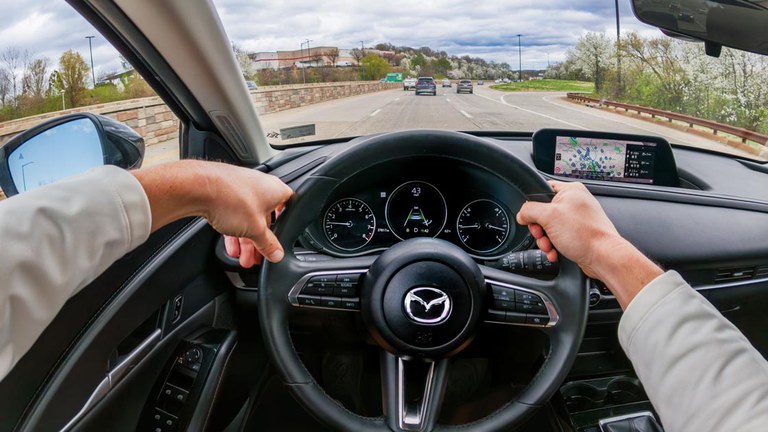
The most basic bundle consisted of a single feature — front automatic emergency braking (AEB), which in all these vehicles included forward collision warning. The most comprehensive bundle included front AEB with pedestrian detection, adaptive cruise control, high-beam assist, lane departure warning, lane departure prevention, rear AEB, and Driver Attention Alert — a feature designed to detect when the driver is fatigued or distracted.
Bigger bundles, bigger benefits
Not only were the larger bundles more comprehensive, but they also included more advanced versions of the technologies in the smaller bundles. That’s because they were offered on newer vehicles. At the same time as Mazda was introducing new features, it was refining the older ones. Thus, while all the bundles included front AEB, the biggest bundles included a more advanced version of it.
The reductions in claim frequency were substantial, especially under property damage liability (PDL) and bodily injury liability (BIL) coverages. PDL coverage pays for crash damage that the at-fault driver’s vehicle causes to other people’s vehicles or property. BIL coverage pays to treat injuries caused to people in other vehicles or other road users.
The most basic bundle was associated with a 13% reduction in PDL claim rates and a 9% reduction in BIL claim rates. In general, those benefits grew with the addition of each new technology, and the most comprehensive bundle was linked to a 39% drop in PDL claim rates and a 21% fall in BIL claim rates, though the latter figure was not statistically significant.
