
We made flying nearly collision-proof decades ago. Why are intersections still so dangerous? (Fast Company)
Shift into Safe News
On average, 11 car crashes occur every minute in the U.S. By the time you finish reading this sentence, several vehicle collisions will have happened across the country, some of which were likely fatal.
In the world of aviation, the number of crashes involving U.S. civilian aircraft is about 1,200 per year, and very few of those result in fatalities.
Despite the 5,500 American planes that are in the air at any given moment during peak times, collisions are rare, because airspace is designed for safety. Planes are required to communicate with one another and with ground control. No one gets to “opt out.”
Our roads are another story. More than 280 million registered vehicles share U.S. streets with trucks, cyclists, and pedestrians — largely without any systemic communication. This isn’t a failure of drivers or technology, but a failure of system design.
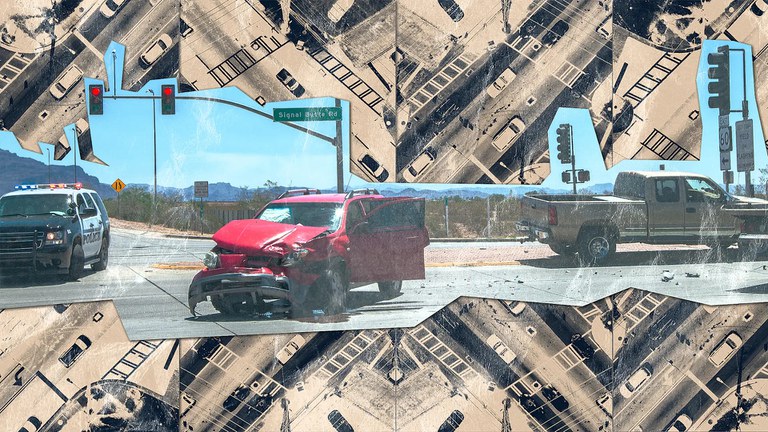
Anyone who’s waited at a busy intersection understands how much uncertainty we accept as normal. Roadways are open systems with infinite variables—weather, pedestrians, distracted drivers and aging infrastructure. Communication between vehicles is minimal, and infrastructure is largely silent — and in that gap lies the potential for deadly collisions.
The lesson from aerospace is clear: Safety comes from mandatory communication and a shared system design, not from relying on each vehicle to figure it out on its own.
In aerospace, safety is designed into the system from day one. Aircraft continuously share their position and movement through standardized sensing and communication systems. Flight plans and operating rules allow ground systems to understand intent and predict where aircraft are headed next.
This creates a shared, real-time picture of the airspace. Humans and automated systems can spot conflicts early, coordinate decisions, and resolve risks long before paths intersect.
If we can engineer safety for aircraft moving at hundreds of miles per hour, we can do the same for streets moving at 30 mph.
Most traffic systems today are built to react after something goes wrong. Predictive systems are designed to intervene before conflict turns into a crash. But for safety systems to work, intelligence must live in the environment itself — not just inside individual vehicles.
