
Speed violation warnings begin March 1 on I-25 between Mead and Berthoud
Travel Advisory
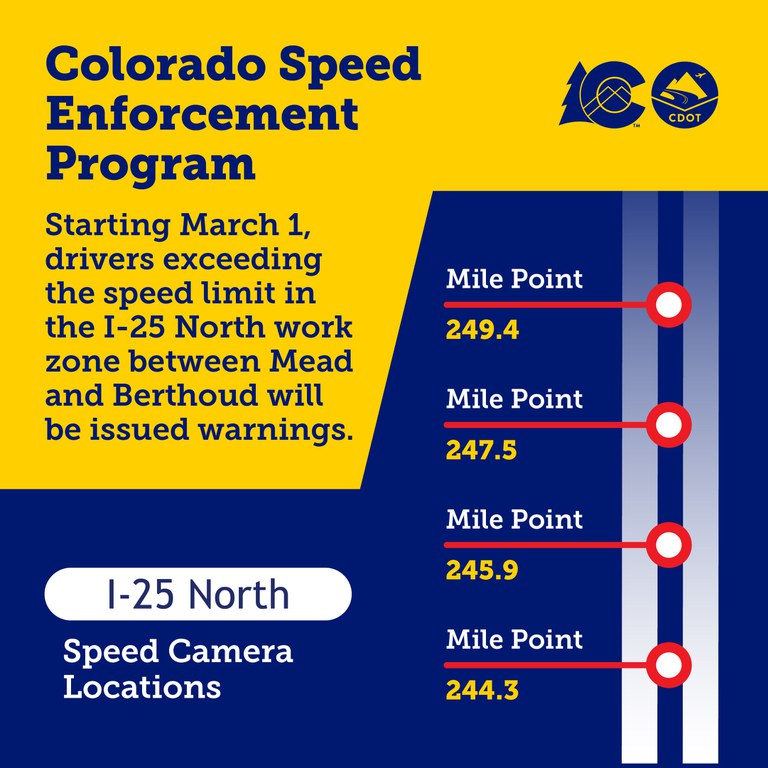
Weld County — On March 1, the Colorado Department of Transportation’s Colorado Speed Enforcement Program will start issuing warnings to drivers who exceed the posted speed limit in the Interstate 25 North Express Lanes work zone between Mead and Berthoud in northern Colorado.
The warning period on I-25 marks the second active corridor of the Colorado Speed Enforcement Program, which uses camera technology to reduce speeding in high-risk corridors, such as active construction zones. Preliminary data from the cameras show more than 10% of drivers in the I-25 work zone corridor exceeded the posted 65 mph speed limit by more than 10 mph during the testing period. CDOT reminds drivers that exceeding the speed limit by 25 mph or more remains a ticketable offense. The goal of the program is to reduce speed-related crashes and improve safety for drivers, roadway workers, law enforcement and other vulnerable road users.
“I-25 carries a high volume of traffic, and when you combine that with active construction, the margin for error gets very small,” said CDOT’s Chief Engineer Keith Stefanik. “This warning period gives drivers time to adjust their behavior before fines begin, because slowing down and not exceeding the speed limit is one of the simplest and most effective ways to keep everyone safe.”
Speeding is a dangerous behavior that continues to cause preventable crashes and fatalities in Colorado. Preliminary data shows that there were over 1,200 speeding-related crashes in Colorado in 2025, resulting in 91 total fatalities. Despite the known risks, 70% of Coloradans admitted to speeding on main and local highways, according to a 2025 CDOT survey.
Colorado law authorized the use of automated speed enforcement in 2023. The Colorado Speed Enforcement Program first launched in July 2025 on Colorado Highway 119 between Boulder and Longmont (the Diagonal Highway), and speeding violations have since dropped by more than 80% on that corridor.
On the program’s newest corridor, I-25 North, cameras were installed in late January between Mead and Berthoud, where crews are constructing new Express Lanes in both directions. Warnings will be issued for at least 30 days before civil penalties begin. Civil penalties carrying a fine of $75 in this corridor are expected to begin on April 2, 2026. The presence of speed cameras is clearly marked by signage at least 300 feet in advance.
In active enforcement zones, vehicles are photographed and time stamped at two locations, allowing the system to calculate an average speed through the corridor. On the I-25 corridor, eight speed cameras are placed in both directions at Mile Points 244.3, 245.9, 247.5 and 249.4.
During the warning period, drivers exceeding the posted speed limit will receive a one-time warning notice instead of a fine.
Once civil penalties are underway:
- Drivers will have 45 days to pay or appeal the notice
- Violations captured by the Automated Vehicle Identification System (AVIS) will not result in points on a driver’s license
- Drivers will have 45 days to pay the $75 fine or appeal the notice
Revenue collected from the penalties will be used primarily to fund the Speed Enforcement Program. Any excess funds will be allocated to the Vulnerable Road User Protection Enterprise, which provides infrastructure improvements that protect vulnerable road users.
Colorado Speed Enforcement Program cameras work by using a point-to-point system, which measures the average speed of a vehicle over a set distance. The average speed of a vehicle is then calculated by dividing the distance by the travel time. According to the Federal Highway Administration, the use of point-to-point speed cameras has been shown to reduce roadway injuries and fatalities by 20 to 37%.
The goal of the I-25 North Express Lanes project between Mead and Berthoud (Mile Points 243 to 250) is to improve traveler safety in the corridor and install tolling and Intelligent Transportation Systems equipment. The project is expected to conclude in 2028. Learn more about this project and access traffic impacts by visiting the I-25 North Express Lanes webpage. To sign up for project newsletters, visit subscription.cotrip.org/alerts/construction.
For more information about the Colorado Speed Enforcement Program, visit codot.gov/programs/speedenforcement.
About the Colorado Speed Enforcement Program
In 2024, speeding was the most common cause of fatal crashes in Colorado. The dangers of speeding are especially high in work zones, where challenging conditions and vulnerable roadside workers create hazardous circumstances. The Colorado Department of Transportation’s Colorado Speed Enforcement Program aims to reduce speed-related crashes and fatalities on Colorado roads and improve safety for drivers, road workers, vulnerable road users and law enforcement. Using Automated Vehicle Identification Systems (AVIS) in high-risk, CDOT-owned corridors, cameras identify vehicles traveling an average of 10 MPH or more over the posted speed limit and automatically issue $75 civil penalties to the registered owner of the vehicle. The program will start first on CO 119 and is expected to expand into school zones and other high-risk corridors in the future. More information about the Colorado Speed Enforcement Program can be found at codot.gov/programs/speedenforcement.
Know Before You Go
Travelers are urged to “know before you go.” Gather information about weather forecasts and anticipated travel impacts and current road conditions prior to hitting the road. CDOT resources include:
- Road conditions and travel information: COtrip.org
- Download the COtrip Planner app: bit.ly/COtripapp
- Sign up for project or travel alerts: bit.ly/COnewsalerts
- Check scheduled construction lane closures: bit.ly/laneclosures
- Connect with @ColoradoDOT on social media: X, Facebook, Instagram and YouTube
Remember: Slow For The Cone Zone
The following tips are to help you stay safe while traveling through maintenance and construction work zones.
- Do not speed in work zones. Obey the posted speed limits.
- Stay Alert! Expect the unexpected.
- Watch for workers. Drive with caution.
- Don't change lanes unnecessarily.
- Avoid using mobile devices such as phones while driving in work zones.
- Turn on headlights so that workers and other drivers can see you.
- Be especially alert at night while driving in work zones.
- Expect delays, especially during peak travel times.
- Allow ample space between you and the car in front of you.
- Anticipate lane shifts and merge when directed to do so.
- Be patient!
Download the COtrip App!
The new free COtrip Planner mobile app was designed to meet the growing trend of information on mobile and tablet devices for the traveling public. The COtrip Planner app provides statewide, real-time traffic information, and works on mobile devices that operate on the iOS and Android platforms. Visit the Google Play Store (Android devices) or the Apple Store (iOS devices) to download!
