
Warm weather coincides with increase in traffic deaths in 2025
News Release
For access to the media kit, email [email protected]
Statewide — Following two years of declining fatalities, traffic deaths in Colorado increased in 2025. Preliminary data released today by the Colorado Department of Transportation shows 701 people were killed on Colorado roadways in 2025, up from 689 in 2024. While the increase is small, it signals that driving behaviors may be trending in the wrong direction — particularly when it comes to impaired driving and protecting vulnerable roadway users like pedestrians and cyclists.
Until the unseasonably warm months of November and December, traffic deaths were on track for a 7% decline in 2025. The mild temperatures brought more people out onto the roads, which coincided with fatalities to spike near record levels. During those final two months, deaths jumped 70% compared to the same period in 2024. The surge was most visible along the Front Range, where the warm weather was most predominant. And as motorcycle crashes are closely linked to warmer weather, motorcyclist fatalities saw a 167% increase compared to this same time last year.
The 2025 Colorado traffic death data* includes:
- All traffic deaths — 701 (up 2% from 2024)
- Passenger vehicle deaths — 392 (up 5% from 2024)
- Motorcycle deaths — 147 (down 11% from 2024)
- Impaired driving deaths — 235 (up 11% from 2024)
- Unbuckled seat belt deaths — 188 (down .05% from 2024)
- Pedestrian deaths — 126 (up 5% from 2024)
- Bicycle deaths — 18 (up 29% from 2024)
- Construction zone deaths — 9 (down 70% from 2024)
*Data is preliminary. A dashboard with all Colorado traffic fatality data can be found here.
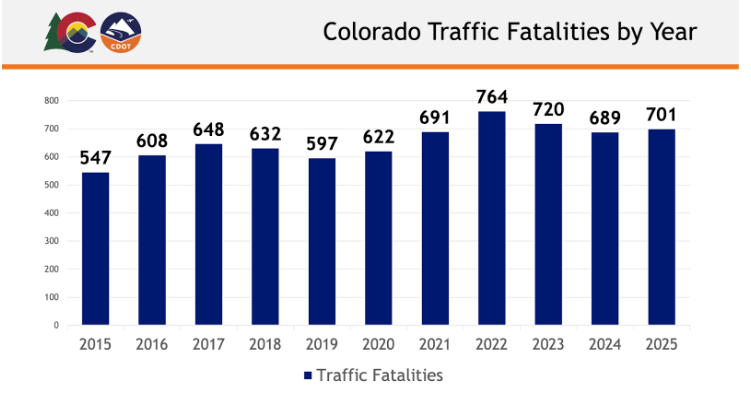
A significant concern in the 2025 data is the safety of people outside vehicles. Bicycle and pedestrian-related deaths continue to increase, up 5% over the previous year. These figures underscore the importance of Senate Bill 25-030, which requires CDOT and local municipalities to identify and close infrastructure gaps by July 2026. By prioritizing the safety of those walking, rolling and biking, the state aims to reverse this trend through better-connected bike lanes, improved crosswalk visibility and more robust pedestrian-focused signal timing.
“Every one of the 701 deaths last year represents a member of our community. Each number is a mother, father, son, daughter or friend who didn't make it home,” said CDOT Executive Director Shoshana Lew. “We can all do more to prevent these crashes. Let’s redouble our efforts to help each other get home safely.”
The cities with the highest fatalities in 2025 include:
- Denver — 76 (up 21% from 2024)
- Aurora — 55 (up 22% from 2024)
- Colorado Springs — 49 (up 4% from 2024)
- Pueblo — 21 (same amount from 2024)
- Lakewood — 16 (down 24% from 2024)
The counties with the highest fatalities in 2025 include:
- Denver — 76 (up 21% from 2024)
- Weld — 76 (up 13% from 2024)
- El Paso — 75 (down 4% from 2024)
- Adams — 59 (down 30% from 2024)
- Arapahoe — 59 (up 7% from 2024)
- Jefferson — 47 (down 13% from 2024)
- Pueblo — 40 (up 60% from 2024)
- Larimer — 36 (up 3% from 2024)
- Douglas — 26 (up 37% from 2024)
- Boulder — 19 (down 17% from 2024)
“The data from 2025 is a sobering reminder that we cannot become complacent. While we’ve seen progress in the past, an 11% increase in impaired driving deaths and a significant rise in bicyclist fatalities tell us that reckless choices are still destroying Colorado families,” said Col. Matthew C. Packard, chief of the Colorado State Patrol. “Removing impaired drivers from our roads remains our top priority, but law enforcement cannot be everywhere. We need every driver to take personal responsibility. Put the phone down, stay within the speed limit and never get behind the wheel if you’ve been consuming alcohol or cannabis. A commitment to sober, focused driving is what will save lives in 2026.”
In an effort to protect roadway users in Colorado, CDOT’s Strategic Transportation Safety Plan has a goal of reducing fatalities and serious injuries by five percent per year or 22.6% by 2030. Strategies to accomplish this goal encompass a host of strategies in five different emphasis areas: Safe Roads, Safe People, Safe Driving, Safety Culture and Post Crash Care. These strategies include:
- Expansion of the speed enforcement program in construction zones.
- Continued improvements to bicycle and pedestrian infrastructure.
- Implementation of 15 impairment enforcement campaigns and three Click It Or Ticket campaigns by local and state law enforcement.
- First-year usage of the Greenland I-25 Wildlife Overpass to prevent wildlife collisions.
- Support for mass transit options, including Bustang, one of the safest ways to travel.
- Support for 130 law enforcement, public health and traffic safety organizations to address impaired driving, seat belt use, teen driving and more at the local level.
- Promoting the state’s Roadmap to Reduce Auto Insurance, which highlights the state's success and continued work of improving safety and reducing crashes.
- Spearheading the Advancing Transportation Safety initiative, which involves 57 identified strategies and over 20 agencies and organizations working on five emphasis areas: Safe Roads, Safe People, Safe Driving, Safety Culture and Post Crash Care.
"The DMV is committed to saving lives through comprehensive strategies, including working with law enforcement to make it easier to identify uninsured motorists, as well as implementing the new, more rigorous minor driver education rules starting in 2027, and continued prevention programs like the Ignition Interlock program," said Electra Bustle, senior director of the Colorado Division of Motor Vehicles. "Our efforts in education, prevention and enforcement are all part of our commitment to safety on Colorado roads and supporting every driver in making responsible decisions every time they drive."
With 2026 well underway, motorists are also reminded of the full implementation of the Colorado Hands-Free Law. After a successful first year, law enforcement continues to strictly cite drivers for holding mobile electronic devices while behind the wheel. Additionally, updated child restraint laws are now in full effect, requiring booster seats for children until age nine and rear-facing seats until age two. These legislative shifts, combined with expanded Express Lane weaving enforcement and CDOT’s Speed Camera Enforcement Program, are critical components of the state's approach to reaching its safety milestones.
Crash Not Accident
Note to reporters: Crashes are no accident — they are preventable. We would appreciate you saying 'crash' instead of 'accident' when reporting.
