
$75 fines for speeding begin July 30 in the I-25/US 50B Interchange Reconstruction Project work zone in Pueblo
News Release
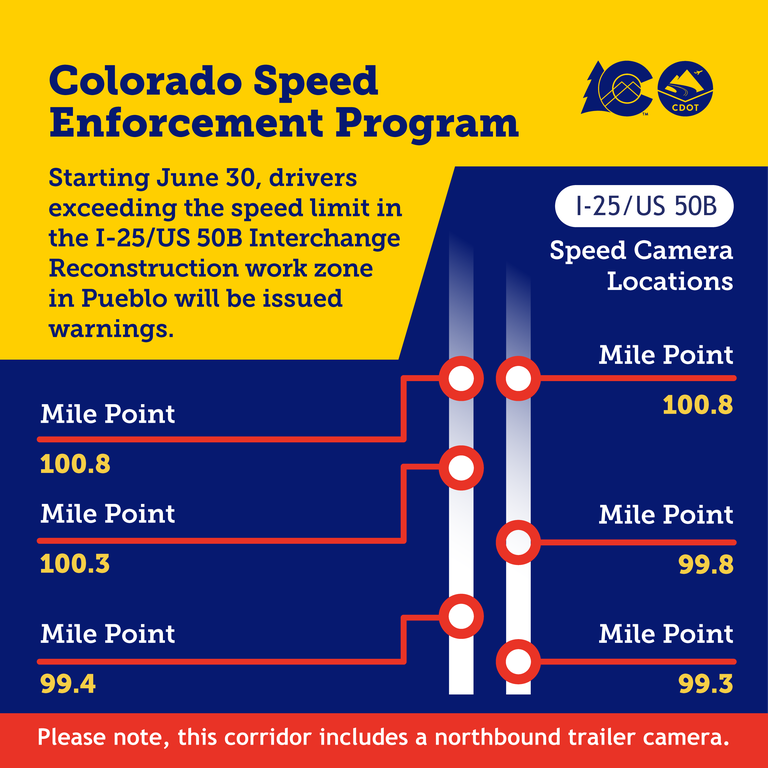
Statewide — Starting Thursday, July 30, 2026, the Colorado Speed Enforcement Program will issue $75 fines to drivers speeding in the I-25/US 50B Interchange Reconstruction Project work zone in Pueblo. The Colorado Department of Transportation’s program uses camera technology to automatically enforce speed limits in high-risk areas and decrease the risk of deadly crashes.
On June 30, 2026, the required 30-day warning period began on I-25/US 50B in Pueblo, providing motorists time to adjust to work zone speed enforcement without penalty and reduce excessive speeds before $75 fines take effect. Since warnings began, more than 11,000 violations have been issued, and excessive speeds on the corridor have decreased by nearly 67%.
Starting July 30:
- Drivers who exceed the speed limit by 10+ mph will be issued a $75 fine, mailed to the registered owner of the vehicle
- Drivers will have 45 days to pay the $75 fine or appeal the notice
- Violations captured by the Automated Vehicle Identification System (AVIS) will not result in points on a driver’s license
Program Results
- CO 119: Excessive speeding down 83%
- I-25 North: Excessive speeding down 93%
- I-25/US 50B: Excessive speeding down 67%
About the Colorado Speed Enforcement Program
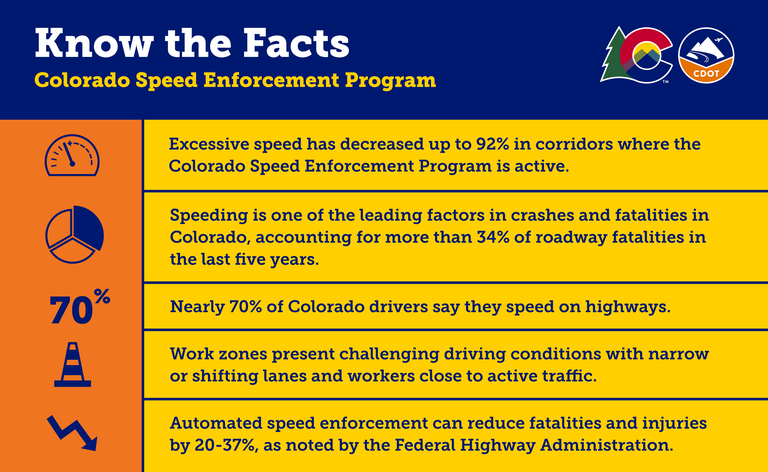
Speeding has been involved in at least one third of all crash fatalities in Colorado from 2023 to 2025, contributing to at least 728 deaths. The Colorado Department of Transportation’s Speed Enforcement Program aims to reduce speed-related crashes and fatalities on Colorado roads and improve safety for drivers, road workers, vulnerable road users and law enforcement. Using Automated Vehicle Identification Systems (AVIS) in high-risk, CDOT-owned corridors, cameras identify vehicles traveling an average of 10 mph or more over the posted speed limit and automatically issue $75 civil penalties to the registered owner of the vehicle. The program is currently active on Colorado Highway 119 between Boulder and Longmont, I-25 North between Mead and Berthoud, and I-25 at US 50B in Pueblo, with additional corridors planned.
The program uses a point-to-point (P2P) system, which is different from typical radar enforcement. Instead of tracking a motorist’s speed at a moment in time, the P2P system measures the average speed of a vehicle over a set distance. According to the Federal Highway Administration, the use of point-to-point speed cameras has been shown to reduce roadway injuries and fatalities by 20 to 37%.
Revenue collected from civil penalties will be used primarily to cover program-related costs. Any excess revenue will be allocated to the Vulnerable Road User Protection Fund, which provides infrastructure improvements that protect vulnerable road users, such as pedestrians and cyclists.
CDOT’s speed enforcement cameras are distinct from Flock camera systems used for criminal investigation. Data collected through CDOT’s Colorado Speed Enforcement program is used only for limited purposes as allowed under Colorado law. Cameras are programmed to only photograph license plate information when triggered by a violation, and captured images are destroyed three years after the violation is resolved.
More information about the Colorado Speed Enforcement Program is available at codot.gov/programs/speedenforcement.
