CDOT celebrates completion of I-70 West Vail Pass Auxiliary Lanes project
News Release
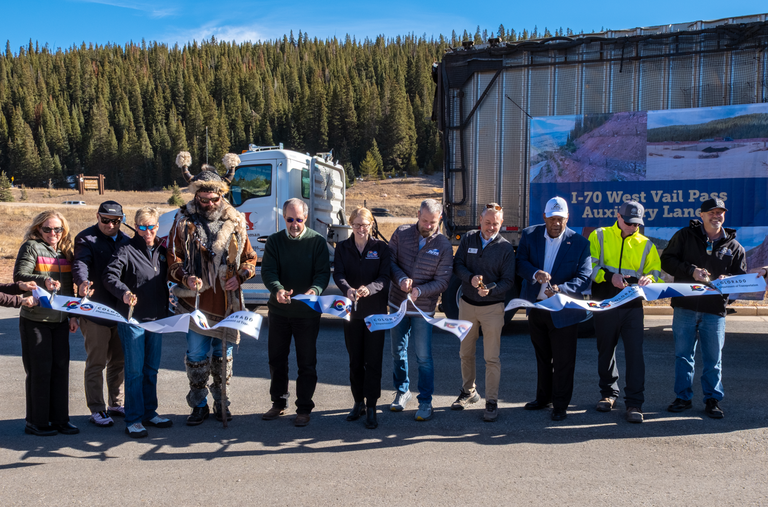
Eagle County — Colorado Department of Transportation officials gathered with prime contractor Kiewit Infrastructure Co., the Federal Highway Administration, local elected leaders and transportation partners and stakeholders at the Vail Pass Rest Area to celebrate the completion of the I-70 West Vail Pass Auxiliary Lanes project. Special guest Ullr, the mythical Norse patron of skiing and winter, was also in attendance to signify the vital role Vail Pass plays in Colorado’s winter economy as a mountain recreation corridor.
Stretching across 10 miles of challenging, high-elevation mountain terrain from the East Vail Interchange (Mile Point 180) to the Vail Pass Rest Area (MP 190), West Vail Pass is one of Colorado’s most critical and weather-impacted interstate corridors. Spurred by an initial $60.7 million Federal Infrastructure for Rebuilding America grant, paired with state matching funds and FHWA allocations, the six-year effort delivers key safety, operational and environmental upgrades to reduce crashes, minimize full interstate closures and preserve nearby natural ecosystems.
Vail Pass presents some of the most challenging terrain on Colorado’s highway system,” said CDOT Executive Director Shoshana Lew. “All of the components of this project — from widened shoulders for emergency responders to cutting-edge avalanche mitigation improvements that will protect travelers and avoid road closures for avalanche control work — will make this corridor safer and more dependable. We appreciate all of the collaboration that got us to this milestone.”
“This project stands as a testament to what can be achieved through strong interagency coordination, innovative engineering, and dedicated community partners,” said FHWA Division Administrator John Cater. “These infrastructure investments ensure that I-70 over Vail Pass remains a safe, resilient and reliable interstate connection far into the future.”
Roadway improvements
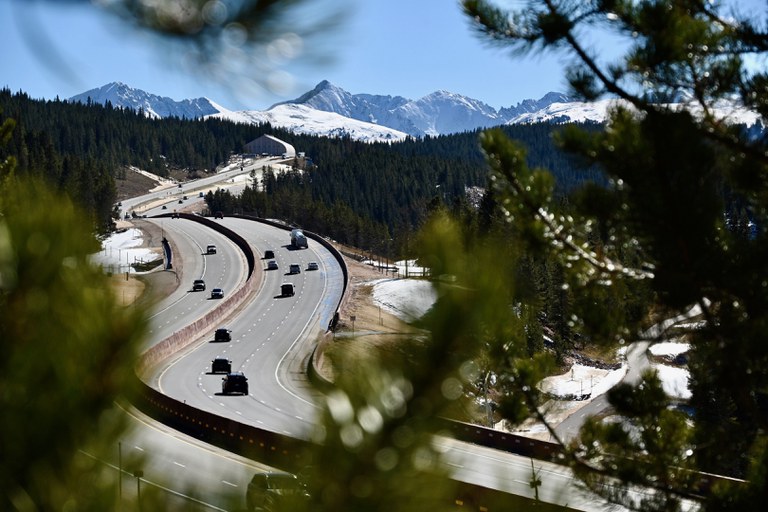
- Eastbound auxiliary lane – A continuous third eastbound climbing lane between MP 187 and Vail Pass’s Summit (MP 190) that separates slow-moving heavy vehicles from lighter passenger traffic, reducing speed-differential crashes.
- Reconstructed bridges and curve realignment – Modernized dual bridges near MP 185 engineered with a 100-year service life, realigned to soften the sharp curves and shifted north to protect Polk Creek.
- Relocated Vail Pass Recreation Path – To make room for road improvements, the path was moved further south from the interstate lanes between MP 185 and MP 187, resulting in a safer, smoother experience for cyclists and trail users.
- U.S. Forest Service trailhead parking expansion – Partnered with the U.S. Forest Service to expand and improve the trailhead parking lot along Bighorn Road in East Vail. Built by beneficially repurposing excavated rock and soil from the highway corridor, the expanded lot improves recreation access to the popular Gore Lake and Deluge Lake trailheads while reducing parking spillover and pedestrian/vehicle conflicts along the adjacent Vail Pass Recreation Path.
CDOT operations
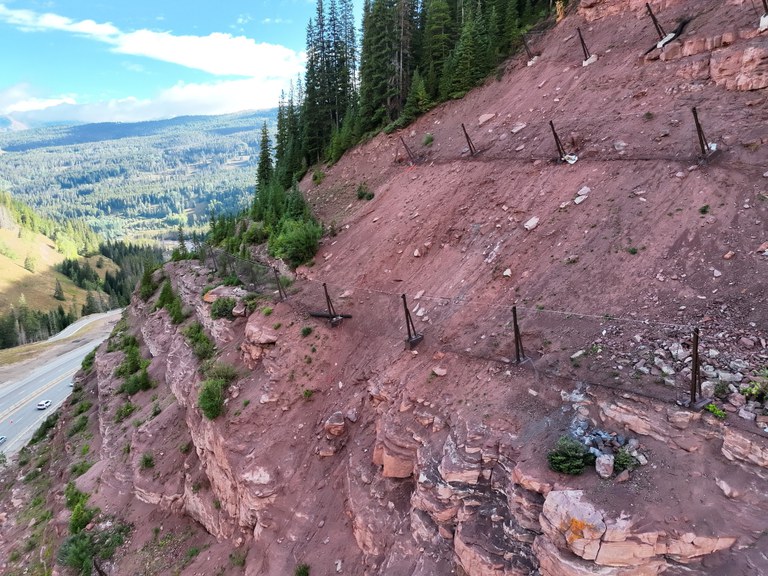
- Passive avalanche and rockfall mitigation system – Installed in an area known as the “Narrows” near MP 186, this system — the first of its kind in Colorado — allows CDOT and the Colorado Avalanche Information Center to safely monitor and manage active avalanche paths limiting extended multi-hour closures and potential detours.
- Intelligent Transportation System signage – Installed a new overhead variable message sign near MP 186.5, uphill of the Narrows, to form an Active Transportation Management System that conveys lane closures and warnings to drivers.
Environmental stewardship
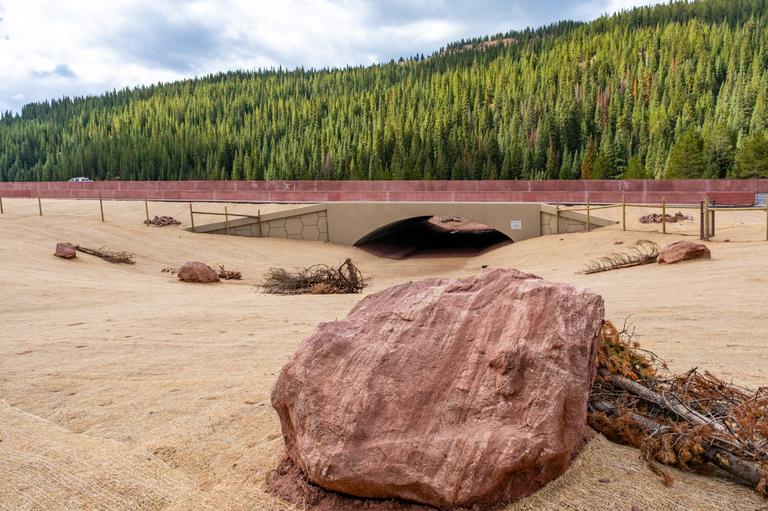
- Five wildlife underpasses & fencing – Five new wildlife underpasses (two large, three small-to-medium) and exclusionary fencing between MP 187 and MP 190 reconnect vital wildlife movement corridors for high-elevation species including Canada lynx, elk, moose and deer — projected to cut wildlife-vehicle collisions by 80% to 90%.
- Sediment control and environmental stewardship – Upgraded Sediment Control Action Plan basins to trap winter traction sand and highway runoff before reaching Gore Creek and Polk Creek, preserving vital trout and insect habitats.
“This stretch of I-70 cuts through one of Colorado's important high-country wildlife movement corridors,” said Colorado Parks and Wildlife Director Laura Clellan. “These five underpasses paired with exclusionary fencing form the first multi-crossing system along the mountain corridor, restoring connectivity for wildlife including Canada lynx, elk and mule deer while preventing dangerous and costly collisions over the decades to come.”
Freight Operations
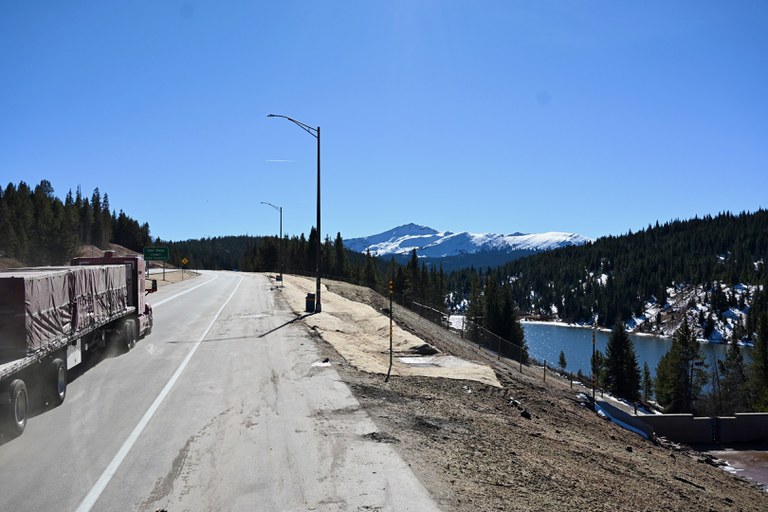
- Improved emergency truck ramp & containment – Reconstructed just east of West Vail at MP 182 with a straighter entry path to prevent runaway truck rollovers, featuring an integrated hazardous materials settlement basin to protect nearby Gore Creek and local water resources.
- Expanded commercial truck parking – Expanded truck parking along I-70 to give drivers an essential safe space to rest and prepare for mountain conditions, built cost-effectively by repurposing excavated soil on site.
“Together, these improvements enhance safety for commercial drivers and the traveling public, strengthen freight movement and support Colorado's economy,” said Craig Hurst, assistant director of the Division of Transportation Development, Office of Freight Mobility & Safety. “CDOT will continue investing in the corridor, including future improvements to chain station infrastructure.”
In addition, crews installed utility trenching and fiber-optic infrastructure to power the corridor’s Intelligent Transportation Systems — including variable speed limit signs, weather sensors, and automated traffic management — alongside extensive asphalt resurfacing engineered to withstand Vail Pass’s severe freeze-thaw cycles.
Project funding & partners
The $340 million project was delivered through a combination of a $60.7 million federal INFRA grant, CDOT state matching funds, and FHWA program allocations. Key participating agencies and stakeholders include CDOT, FHWA, Kiewit Infrastructure Co., the U.S. Forest Service, Colorado Parks and Wildlife, Colorado Avalanche Information Center, Eagle County, Town of Vail and the I-70 Coalition.
Project Information
To learn more about the I-70 West Vail Pass Auxiliary Lanes project, visit codot.gov/projects/i70westvailauxiliarylanes
Know Before You Go
Travelers are urged to “know before you go.” Gather information about weather forecasts and anticipated travel impacts and current road conditions prior to hitting the road. CDOT resources include:
- Road conditions and travel information: COtrip.org
- Download the COtrip Planner app: bit.ly/COtripapp
- Sign up for project or travel alerts: bit.ly/COnewsalerts
- Check scheduled construction lane closures: bit.ly/laneclosures
- Connect with @ColoradoDOT on social media: X, Facebook, Instagram and YouTube
Remember: Slow For The Cone Zone
The following tips are to help you stay safe while traveling through maintenance and construction work zones.
- Do not speed in work zones. Obey the posted speed limits.
- Stay Alert! Expect the unexpected.
- Watch for workers. Drive with caution.
- Don't change lanes unnecessarily.
- Avoid using mobile devices such as phones while driving in work zones.
- Turn on headlights so that workers and other drivers can see you.
- Be especially alert at night while driving in work zones.
- Expect delays, especially during peak travel times.
- Allow ample space between you and the car in front of you.
- Anticipate lane shifts and merge when directed to do so.
- Be patient!
Download the COtrip App!
The new free COtrip Planner mobile app was designed to meet the growing trend of information on mobile and tablet devices for the traveling public. The COtrip Planner app provides statewide, real-time traffic information, and works on mobile devices that operate on the iOS and Android platforms. Visit the Google Play Store (Android devices) or the Apple Store (iOS devices) to download!
About CDOT
The Colorado Department of Transportation’s mission is to provide the best multi-modal transportation system that most effectively and safely moves people, goods and information. CDOT maintains more than 23,000 lane miles of highway, more than 3,400 bridges and 35 mountain passes. Our team of employees works tirelessly to reduce the rate and severity of crashes and improve the safety of all modes of transportation. CDOT leverages partnerships with a range of private and public organizations and operates Bustang, an interregional express bus service. Find more details at codot.gov.
