
The Colorado Speed Enforcement Program will soon begin issuing civil penalties for speeding in the Colorado Highway 119 work zone
Shift into Safe News
Starting early 2026, CDOT will begin issuing fines for speeding in the CO 119 work zone between Boulder and Longmont. Drivers exceeding the speed limit will be subject to fines of $75. The warning period, which began in July 2025, will remain active until civil penalties take effect.
As the civil penalty start date approaches, CDOT is addressing some common questions about the program. The short of it? We’re not out to get you — we’re more concerned with getting you safely to your destination.
Why is this program being implemented?
The Colorado Speed Enforcement Program aims to reduce the number of speed-related crashes and fatalities in vulnerable areas such as work and school zones. Speeding is a leading contributor to traffic fatalities each year in Colorado, and work zones are especially dangerous as narrow lanes and unique configurations require a driver’s full attention and compliance with reduced speeds.
Automated speed enforcement is a proven way to decrease speed-related fatalities, according to the Federal Highway Administration. One month after the warning period began on CO 119, average speeds decreased by an average of 8 mph in the work zone.
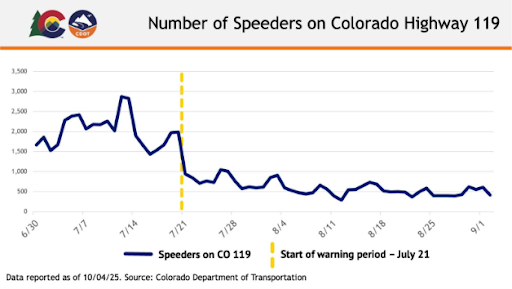
Since the Colorado Speed Enforcement Program launched on CO 119, between Boulder and Longmont, there has been a more than 80% decrease in speeding.
How do the cameras work?
The Colorado Speed Enforcement Program uses Point-to-Point (P2P) technology to calculate speed, issuing violations to drivers who exceed the posted speed limit. Unlike speed radars, P2P technology works by calculating the vehicle’s average speed over the distance traveled using timestamped images of the vehicle at several points.
Is the use of speed camera technology in Colorado legal?
Yes! Colorado Revised Statute 42-4-110.5 authorizes the use of automated vehicle identification systems (AVIS), or speed cameras, to enforce traffic laws in corridors at high risk of speed-related crashes and fatalities.
How is data collected by the program handled?
Your privacy is protected.
Cameras are programmed to only keep footage when a speed violation is detected. All photos and videos are confidential and protected by law — they are not public record.
Collected data is only used for the necessary operation of the program, such as processing violations or for other enforcement purposes permitted by law. Once a violation is resolved, all photos must be destroyed within three years.
Where will money collected from the civil penalties go?
The revenue collected from civil penalties is primarily used to fund this program, making it a self-sustaining safety initiative that can be implemented in other high-risk corridors. Any excess revenue is directed to the Vulnerable Road User Protection Enterprise, a fund dedicated to building safer infrastructure, such as sidewalks for pedestrians and protected bike lanes for cyclists.
For more information about the Colorado Speed Enforcement Program, please visit the program website at codot.gov/programs/speedenforcement.
