
Safe Routes to School
About the Program
Overview
The Colorado Department of Transportation (CDOT), guided by Colorado regulations and a Transportation Commission resolution, administers the Colorado Safe Routes to School (SRTS) program, which includes the following elements:
- Planning and measuring progress - developing a Five-Year Strategic Plan and measuring progress against its goals and intended outcomes.
- Grant management - funding Colorado local projects that improve the built environment near schools, and education, encouragement and/or enforcement activities that encourage safe walking and biking to and from school.
- Communications and outreach - activities that maintain and increase program awareness and participation.
- Education and technical assistance - sharing resources, technical assistance and educational tools for Colorado organizations and communities interested in advancing their SRTS knowledge and skills.
History
The Safe Routes to School (SRTS) concept began in Denmark in the 1970s with a simple vision of making it safer for children to get to school. Over the next three decades, the movement grew globally, while simultaneously the rates of students in the U.S. walking and biking to school decreased from 48 percent to less than 15 percent, and rates of obesity, diabetes and other chronic diseases grew significantly.
Those pressing forces led to multiple pilot projects in the late 1990s in the United States. Positive outcomes from the pilot programs set the momentum for the establishment of the U.S. Safe Routes to School program through the 2005 passage of the Safe, Accountable, Flexible, Efficient Transportation Equity Act: A Legacy for Users (SAFETEA-LU) transportation bill.
Colorado, however, didn’t wait for Congress. In 2004 Colorado became the first U.S. state to codify a state Safe Routes to School program.
Since then, over $48 million has been invested in more than 300 Colorado safety projects such as widening sidewalks, improving crosswalks and building bike lanes.
Our state has also invested resources in educating and engaging parents, students, teachers and school leaders in understanding and integrating safer active transportation practices.
Why are Safe Routes to School important?
SRTS programs can improve safety, not just for children, but for entire communities.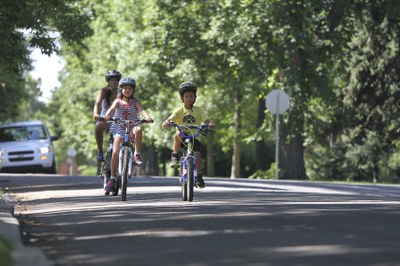
- They provide opportunities for people to increase their physical activity and improve their health.
- They reduce congestion and pollution around our schools.
- They encourage student confidence, partnerships, and relationship-building within our communities.
- By addressing safety, health, and environmental concerns simultaneously, SRTS initiatives offer a holistic strategy to creating better, more vibrant neighborhoods for everyone.
Safe Routes to School Approach — The 6 E's
Getting more students to safely walk and bike to school requires a comprehensive approach, through the “6 E” elements of Safe Routes to School. See below for brief descriptions of each “E”. Visit our Resources page for webinars, tools and resources on how to integrate all 6 “E”s into your SRTS program.
Engagement is the foundation and starting point of all Safe Routes to School initiatives. Engagement is about listening to a potential project’s most impacted community members—the students—as well as families, teachers, school leaders and community organizations. Engaged coalitions work to identify the issues they are facing in their community and conduct ongoing engagement activities, thereby building intentional and strong program structures.
Threaded throughout all elements, equity allocates initiatives and resources based on individual community needs to ensure all communities have the opportunity to succeed. This approach makes necessary adjustments and recognizes that different communities have their own unique barriers regarding integration of SRTS initiatives, which may include disproportionate health, safety and transportation impacts, among other obstacles. A focus on equity ensures that initiatives benefit all demographic groups, with particular attention to low-income students, students of color, students of all genders, students with disabilities, and others.
Engineering projects create physical improvements to streets and neighborhoods that make walking and bicycling safer, more comfortable and more convenient. Engineering activities may include replacing or adding sidewalks, installing pedestrian activated signals, creating bike lanes, school zone signs, etc., to help achieve school goals.
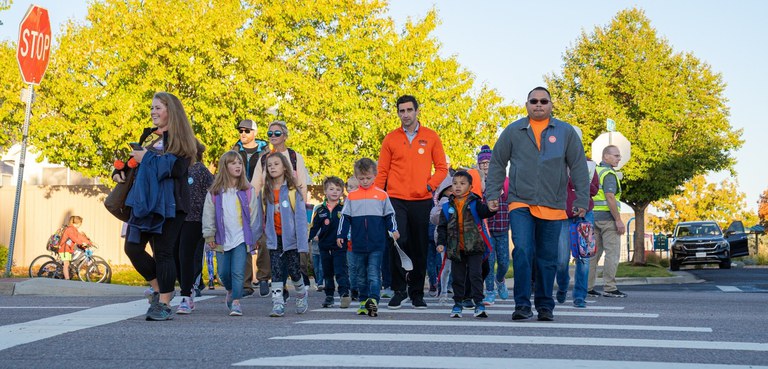
Encouragement helps to inspire students and parents to try bicycling and walking to school, and to make active transportation a regular part of their routines. Encouragement incorporates special events such as Walk or Bike to School Days, as well as ongoing activities and promotions like SRTS walking/biking route maps, Bicycle Trains, and Walking School Buses. See more detail on the Events page.
Education provides students and community members bicycle and pedestrian safety skills and awareness, as well as knowledge of the broad range of benefits afforded by walking and bicycling to school. Educational programs and initiatives may include bicycle and pedestrian safety education curriculum and workshops, and hands-on activities that enable a child to practice in a facilitated, “real world” setting such as through bicycle rodeos or simulated traffic crossings.
Evaluation helps to identify specific issues that pose barriers to students walking and bicycling to school and monitoring trends over time in order to ensure that initiatives are effective. Evaluation includes assessing which approaches are accessible; ensuring that a program or initiative is decreasing health disparities and increasing equity; identifying unintended consequences or opportunities to improve the effectiveness of approaches for specific communities.
