
I-70 Silverthorne/Dillon Interchange Study
Once funding is available for an updated review and improvements to the I-70 Silverthorne/Dillon Interchange (Exit 205), CDOT will refresh the Planning and Environmental Linkages (PEL) Study and design improvements. An updated PEL will be necessary to ensure CDOT is using the most recent data before designing improvements.
As of December 2020, CDOT continues to pursue improvements to the I-70 corridor in Summit County, with the I-70 EB Auxiliary Lane Project from Frisco to Silverthorne, the I-70 Exit 203 Interchange Improvements Study in Frisco and the I-70 Dillon Structure Replacement at Mile Point 211. Work is also underway for the last section of improvements on Colorado Highway 9 between Breckenridge and Frisco, known as the Gap Project.
About the Project
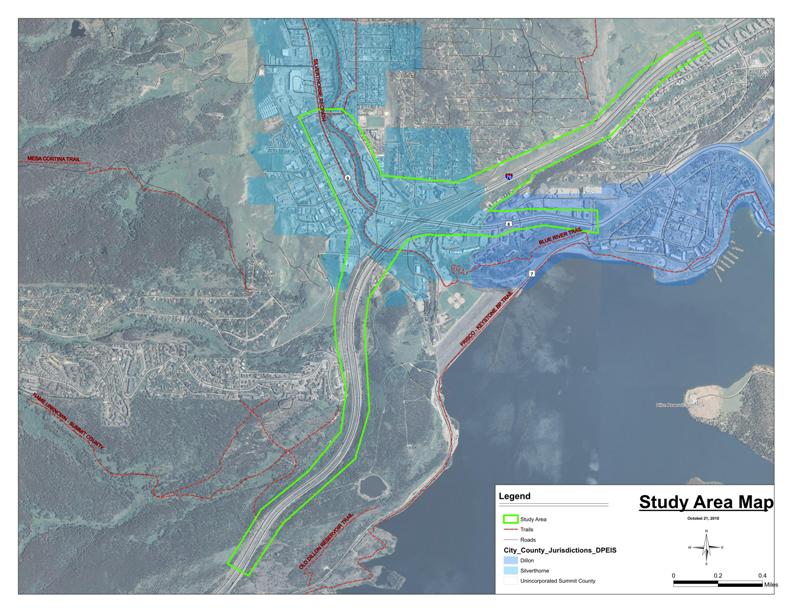
The CO 9/US 6 Improvement Project, formerly known as the I-70 Silverthorne/Dillon Interchange Project, at the I-70 Silverthorne/Dillon Interchange involves evaluating possible improvements to Colorado State Highway 9, US 6 at Exit 205 in Summit County.
Given priority by the I-70 Mountain Corridor Collaborative Effort, the interchange has the heaviest traffic volume in the I-70 Mountain Corridor and has potential for multi-modal enhancements. As volumes and congestion increase, the interchange faces safety, capacity, and mobility challenges in the future.
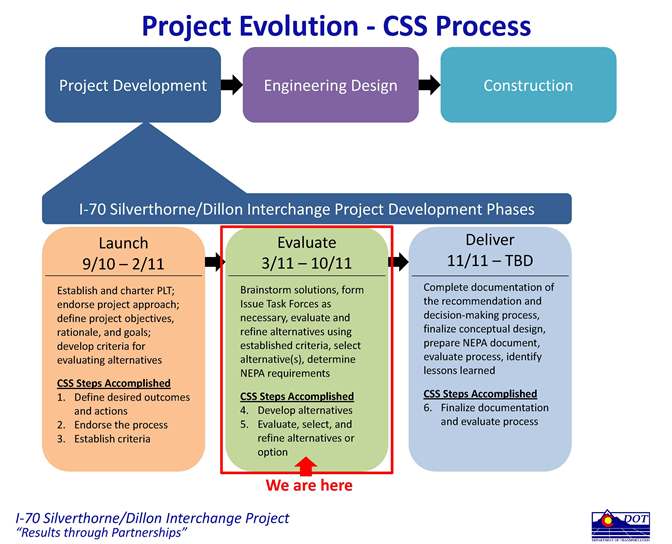
The I-70 Silverthorne/Dillon Interchange Project will be conducted in three phases:
- Launch (September 2010-February 2011): Define desired outcomes and actions, endorse the process, and establish criteria.
- Evaluate (March-October 2011): Develop, evaluate, and refine potential alternatives for further consideration.
- Deliver (November 2011-TBD): Finalize and document the evaluation process, determine next steps for implementation.
The project includes:
- Changing the interchange design
- Improving the westbound I-70 on ramp
- Improving the CO 9/Wildernest intersection
- Construction of a continuous eastbound auxiliary lane from the Frisco interchange to the Silverthorne/Dillon interchange
The recommended improvements would be constructed in phases as funding becomes available. The new interchange design will be a Diverging Diamond.
CDOT will seek funding for the next steps in the process, including compliance with the National Environmental Policy Act (NEPA), obtaining environmental permits, and demonstrating compliance with various environmental laws and regulations. These steps and a formal approval process would be followed by final design and construction.
Planning & Environmental Linkages (PEL) Study
CDOT has finalized PEL Study report that documents the project processes and outcomes. View and download the report below.
- Appendix A - Questionnaire
- Appendix B - Purpose & Need
- Appendix C - Launch Phase Technical Summary
- Appendix D - Feasibility & Concept Level Screening
- Appendix E - Detailed Level Screening Analysis (Part 1)
- Appendix E - Detailed Level Screening Analysis (Part 2)
- Appendix F - Public Involvement Report (Part 1)
- Appendix F - Public Involvement Report (Part 2)
- Appendix G - Environmental Resource Analysis
Project Leadership Team
Mission of the I-70 Silverthorne/Dillon Interchange Project Leadership Team
The mission of the I-70 Silverthorne/Dillon Interchange Project Leadership Team is to deliver a multi-modal transportation project that is a model for the I-70 Mountain Corridor. We will respect community and environmental values while improving safety and mobility by engaging in an inclusive and transparent process that is widely supported and manages expectations. The PLT will champion the CSS process and demonstrate best practices in all respects.
Established Goals for the I-70 Silverthorne/Dillon Interchange Project
The Colorado Department of Transportation (CDOT) will conduct a study of potential improvements to the Interstate 70 (I-70) interchange with U.S. Highway 6 (US 6) and State Highway 9 (SH 9), located in the Town of Silverthorne. The mission is to deliver a multi-modal transportation project that is a model for the I-70 Mountain Corridor. Beginning in September 2010, the project will evaluate and recommend for further consideration alterative options that achieve the following preliminary or draft goals:
- To deliver a project that is a model for the I-70 Mountain Corridor by enhancing mobility -- including multi-modal transportation system performance improvements -- while highlighting a successful collaboration between the Federal Highway Administration (FHWA), CDOT, and local agencies, as well as how value may be generated from the Programmatic Environmental Impact Statement (PEIS).
- To develop an innovative interchange solution that is of appropriate scale; respects community values and environmental resources; meets all of the various stakeholders’ needs; and is consistent with adopted local plans, policies, and economic development objectives.
- To embrace the I-70 Mountain Corridor Context Sensitive Solutions (CSS) decision-making process while adhering to the overall corridor vision and core values. The project will demonstrate best practices in all respects.
- To allow inclusive and transparent stakeholder involvement in the development and selection of alternatives facilitated by a strong, long-term intergovernmental team that manages expectations and allows “no surprises” so that the resulting project can be endorsed and “owned” by the community.
- To improve local traffic flow on U.S. Highway 6 (US 6) and State Highway 9 (SH 9) and regional traffic flow on I-70, US 6, and SH 9, minimizing regional travel times while improving access to major activity centers and providing the appropriate balance of through traffic and local access needs with a long-term transportation vision in mind.
- To include, consider, or not preclude future transit improvements -- including an Advanced Guideway System alignment and possible transit station.
- To improve safety for motorists, transit riders, cyclists, and pedestrians within the project limits.
- To identify, where possible, public and private-sector partnership opportunities to address aesthetics, access, maintenance, local road improvements, and private improvements.
- To define flexible alternatives for interchange phasing, including early action opportunities, that can be built either in whole or in logical phases consistent with available funding and prioritized needs
- To avoid, minimize, and mitigate adverse impacts to the local businesses and surrounding environmental resources -- ultimately improving existing conditions -- consistent with the intent of the CSS process and CDOT’s policies and practices. This will be a “self-mitigating” project, which builds the mitigation into the solution.
- To deliver a project that is economically and physically feasible.
- To incorporate sustainability principles and practices into the decision-making process and the design and construction of future improvements.
Public Involvement
Conducted under the I-70 Mountain Corridor Context Sensitive Solutions Guidance, the I-70 Silverthorne/Dillon Interchange Project will incorporate broad stakeholder involvement in a fair, transparent process. Overseeing this process will be a Project Leadership Team (PLT) that includes representation from CDOT, the Federal Highway Administration, the Town of Silverthorne, the Town of Dillon, and Summit County, as well as environmental and business interests. The PLT will update this site regularly to include information regarding new project developments, upcoming meetings, and other opportunities for public participation. Opportunities for public involvement will be provided throughout each phase of the I-70 Silverthorne/Dillon Interchange Project.
Public Meeting - June 13, 2012
The Colorado Department of Transportation (CDOT) held a public meeting on Wednesday June 13 at the Silverthorne Pavilion, 400 Blue River Parkway, Silverthorne, concerning the State Highway 9/U.S. Highway 6 Improvements Project at the Interstate 70 (I-70) Silverthorne/Dillon Interchange.
The project team presented the proposed package of improvements for the interchange, ramps, and surrounding intersections, which resulted from a detailed analysis using criteria based on significant public input. You can view a video overview of the process and the innovative new approach proposed for the package below.
Also, participants learned about other CDOT Projects including: State Highway 9 and the “Iron Springs” alignment concept for widening north of the Summit County High School, I-70 Landslide Project, Improvements at Rasor Drive, tree removal, construction projects planned for the Summer of 2013 and others.
Public Open House - July 20, 2011
Process/Schedule:
- Project Study Area
- What Issues Are We Trying to Address?
- Evaluation Criteria
- Project Evolution – CSS Process
- Evaluation Phase
Alternatives and Options:
- Alternatives and Options
- No Action – No Build Alternative
- Alternative 1 – Improved Diamond Interchange
- Alternative 2 – Roundabout Interchange
- Roundabouts 101
- Alternative 3 – Single Point Urban Interchange
- Alternative 4 – Diverging Diamond Interchange
- Eastbound Off-Ramp Options
- Westbound On-Ramp Options
Next Steps:
- Public Comments Addressed
- How Will the Alternatives and Options Come Together?
- How Will a Recommended Alternative Be Selected?
Handouts:
Public Open House - November 15, 2010
The Colorado Department of Transportation (CDOT), in cooperation with local governments, held a public open house on November 15, 2010 to discuss the I-70 Silverthorne/Dillon Interchange Project. This project seeks to evaluate potential improvements to the Exit 205 Interchange in order to address mobility, access, and safety issues along with multi-modal connectivity needs.
Listed below is the advertisement for the public open house, power point presentation, video, and boards presented at the open house.
Project Overview
- CSS Context Statement and Core Values
- CSS Process
- Project Schedule
- Project Rationale and Goals
- Project Study Area
Existing Conditions
- Existing Land Use
- Existing Bus Transit
- Intersection Crashes on US 6 and SH 9
- Mainline Crashes on I-70
- Paleontology
- Recreation: Section 4(f) and 6(f)
- Wetlands and Waters of the US
- Origin-Destination (OD) Estimates
- 2035 No-Build Intersection Turning Movement Volumes and Level of Service
Evaluation Criteria:
Critical Issues:
Alternatives and Technical Information
The I-70 Silverthorne/Dillon Interchange Project Team is currently in the process of developing, evaluating, and refining potential project alternatives.
To date, the Project Team has developed three potential interchange alternatives:
Roundabouts are being considered as an element in each of these alternatives; and the Project Team has developed additional options that may be incorporated into each of the alternatives as well, eastbound options and westbound options.
During the first phase of the I-70 Silverthorne/Dillon Interchange Project, the Project Team developed – with input from project stakeholders and the public – context-sensitive criteria by which alternatives will be evaluated. These criteria include feasibility-level criteria, which focus on eliminating alternative(s) that do not meet the project’s purpose and need or are unfeasible; concept-level criteria, which are used to compare alternatives and measure how well an alternative achieves the goals of the project; and detailed-level criteria, which serve as the final step in evaluating alternatives.
The Project Team has taken each of the potential alternatives and options listed above through the first two levels of screening. Before moving on to detailed-level analysis, the Project Team will hold a Public Open House to share its findings with the public and gather input on the alternatives and options under consideration. Following the Public Open House, the Project Team will refine alternatives and options, perform detailed-level analyses, and develop one or more recommended alternatives.
The Project Team welcomes and will consider public input throughout the evaluation process and will continue to share its findings and recommendations.
Mission of the I-70 Silverthorne/Dillon Interchange Project Leadership Team
The mission of the I-70 Silverthorne/Dillon Interchange Project Leadership Team is to deliver a multi-modal transportation project that is a model for the I-70 Mountain Corridor. We will respect community and environmental values while improving safety and mobility by engaging in an inclusive and transparent process that is widely supported and manages expectations. The PLT will champion the CSS process and demonstrate best practices in all respects.
Established Goals for the I-70 Silverthorne/Dillon Interchange Project
The Colorado Department of Transportation (CDOT) will conduct a study of potential improvements to the Interstate 70 (I-70) interchange with U.S. Highway 6 (US 6) and State Highway 9 (SH 9), located in the Town of Silverthorne. The mission is to deliver a multi-modal transportation project that is a model for the I-70 Mountain Corridor. Beginning in September 2010, the project will evaluate and recommend for further consideration alterative options that achieve the following preliminary or draft goals:
- To deliver a project that is a model for the I-70 Mountain Corridor by enhancing mobility -- including multi-modal transportation system performance improvements -- while highlighting a successful collaboration between the Federal Highway Administration (FHWA), CDOT, and local agencies, as well as how value may be generated from the Programmatic Environmental Impact Statement (PEIS).
- To develop an innovative interchange solution that is of appropriate scale; respects community values and environmental resources; meets all of the various stakeholders’ needs; and is consistent with adopted local plans, policies, and economic development objectives.
- To embrace the I-70 Mountain Corridor Context Sensitive Solutions (CSS) decision-making process while adhering to the overall corridor vision and core values. The project will demonstrate best practices in all respects.
- To allow inclusive and transparent stakeholder involvement in the development and selection of alternatives facilitated by a strong, long-term intergovernmental team that manages expectations and allows “no surprises” so that the resulting project can be endorsed and “owned” by the community.
- To improve local traffic flow on U.S. Highway 6 (US 6) and State Highway 9 (SH 9) and regional traffic flow on I-70, US 6, and SH 9, minimizing regional travel times while improving access to major activity centers and providing the appropriate balance of through traffic and local access needs with a long-term transportation vision in mind.
- To include, consider, or not preclude future transit improvements -- including an Advanced Guideway System alignment and possible transit station.
- To improve safety for motorists, transit riders, cyclists, and pedestrians within the project limits.
- To identify, where possible, public and private-sector partnership opportunities to address aesthetics, access, maintenance, local road improvements, and private improvements.
- To define flexible alternatives for interchange phasing, including early action opportunities, that can be built either in whole or in logical phases consistent with available funding and prioritized needs
- To avoid, minimize, and mitigate adverse impacts to the local businesses and surrounding environmental resources -- ultimately improving existing conditions -- consistent with the intent of the CSS process and CDOT’s policies and practices. This will be a “self-mitigating” project, which builds the mitigation into the solution.
- To deliver a project that is economically and physically feasible.
- To incorporate sustainability principles and practices into the decision-making process and the design and construction of future improvements.
Public Involvement
Conducted under the I-70 Mountain Corridor Context Sensitive Solutions Guidance, the I-70 Silverthorne/Dillon Interchange Project will incorporate broad stakeholder involvement in a fair, transparent process. Overseeing this process will be a Project Leadership Team (PLT) that includes representation from CDOT, the Federal Highway Administration, the Town of Silverthorne, the Town of Dillon, and Summit County, as well as environmental and business interests. The PLT will update this site regularly to include information regarding new project developments, upcoming meetings, and other opportunities for public participation. Opportunities for public involvement will be provided throughout each phase of the I-70 Silverthorne/Dillon Interchange Project.
The Colorado Department of Transportation (CDOT), in cooperation with local governments, held a public open house on November 15, 2010 to discuss the I-70 Silverthorne/Dillon Interchange Project. This project seeks to evaluate potential improvements to the Exit 205 Interchange in order to address mobility, access, and safety issues along with multi-modal connectivity needs.
