
US 34 Railroad Crossing Elimination Study
About the Study
Planning Today for a Safer, More Connected Tomorrow
The Colorado Department of Transportation, in conjunction with the Federal Railroad Administration (FRA) and local agencies, is developing alternatives to remove the at-grade railroad crossings on US 34 near Kelim and Johnstown. The implementation of this project will result in a safer and more resilient US 34.
Study Location
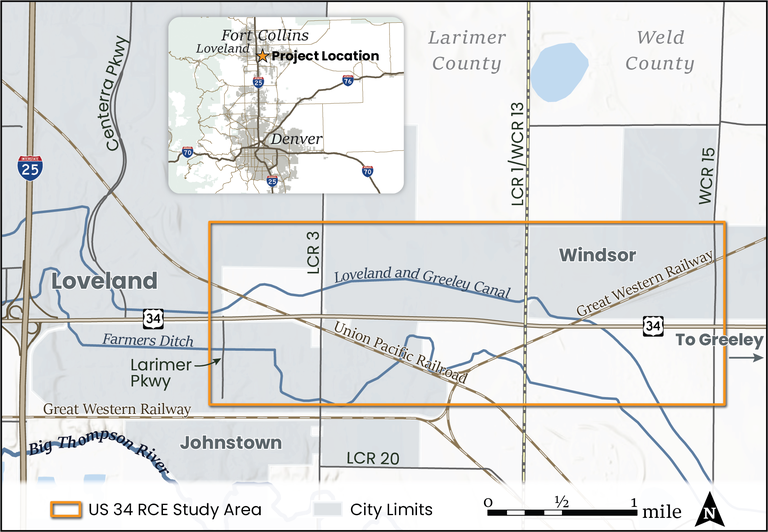
The US 34 RCE study is located in northern Colorado along US 34 between Interstate 25 (I-25) and Weld County Road (WCR) 15. The Study is approximately two and a half miles long and the limits are from Larimer Parkway on the west to WCR 15 on the east. The study includes potentially improving two at-grade intersections, Larimer County Road (LCR) 3 and LCR1/WCR 13, and two at-grade railroad crossings with Union Pacific Railroad (UPRR) and Great Western Railway (GWR).
Schedule & Important Dates
- Purpose and Need Memo Approved: March 2025
- Alternatives Analysis Methodology Memo Approved: April 2025
- Existing Conditions Report Approved: June 2025
- Alternatives Analysis Workshop 1: April 2025
- Alternatives Analysis Workshop 2: July 2025
- Alternatives Analysis Workshop 3: September 2025
- Mobility Advocacy Group Meeting: Summer 2025
- Local Agency Review Meetings (Windsor, Greeley, Loveland & Johnstown): October 2025
- Level I Evaluation of Alternative Design Concepts: Summer 2025
- Level II Alternative Concept Development: Fall 2025
The study’s purpose is to identify existing roadway deficiencies and create several alternative design concepts that would provide safety and transportation improvements. The ultimate goal of this project is to propose an alternative that eliminates the at-grade railroad crossings along US 34. CDOT, with FRA guidance and approval, will design these alternative concepts based on the following improvement goals:
- Improve safety
- Enhance operations
- Improve opportunities for multimodal connectivity
- Accommodate local agency and regional planning efforts
- Increase resiliency
- Consider capital and maintenance costs
The completion of this study will provide transportation improvement alternatives for the elimination of the two at-grade railroad crossings along US 34. These improvements would provide a safer and more reliable transfer of people and goods while also preparing for future travel demands. Study benefits include:
- Improving rail infrastructure to enhance rail safety
- Improving the health and safety of communities
- Eliminating highway-rail and pathway-rail grade crossings that are blocked by trains
- Reducing the impacts that freight movement and railroad operations may have on underserved communities
- Accidents at highway-rail grade crossings is the second leading cause of rail-related deaths in the United States (FRA 2024)
- More than 2,000 incidents and 200 fatalities at the at-grade crossings occur each annually (FRA 2024)
- Within the past year (October 2023 to October 2024), Colorado has had 541 reported incidents at blocked at-grade crossings (FRA 2024)
Where We Are Now
CDOT has been advancing through the Alternatives Analysis process:
- More than 100 initial concepts were developed, grouped, and screened to identify those meeting the study’s Purpose and Need.
- Through stakeholder input and technical evaluations, the list has been refined to six alternatives, now undergoing traffic analysis and modeling to assess feasibility and performance.
These efforts are guided by evaluation criteria which are reflective of the local priorities and long-term regional vision within each alternative concept. CDOT has been working closely with local agencies and GoNoCo34 to understand the priorities of their organizations and communities. This continued effort of transparent communication and interagency collaboration is crucial to providing innovative solutions that address the needs of the corridor.
What’s Next
CDOT will continue refining the alternatives to identify recommendations that best balances safety, mobility, and community needs. While this is a planning study (not yet a construction project), it lays the groundwork for future investment and implementation once funding is identified.
