
About CTIO
CTIO's Mission
- Partner with CDOT, private industry, and local communities
- Aggressively pursue innovative financing alternatives not otherwise available to the state
- Quickly deliver transportation infrastructure options that improve mobility
- Communicate openly with all stakeholders
The Funding Advancement for Surface Transportation and Economic Recovery Act (Part 8 of Article 4, Title 43, Colorado Revised Statutes), otherwise known as FASTER, created the Colorado High Performance Transportation Enterprise (HPTE), now doing business as the Colorado Transportation Investment Office (CTIO), in 2009 as an independent, government-owned business within CDOT.
CTIO has the legal responsibility to aggressively seek out opportunities for innovative and efficient means of financing and delivering important surface transportation infrastructure projects in the state. It has the statutory power, among others, to impose tolls and other user fees, to issue bonds, and to enter into contracts with public and private entities to facilitate Public-Private Partnerships (P3s).
During the 2024 Colorado legislative session, Senate Bill 24-184 (SB 24-184), concerning the support for surface transportation development, was signed into law by Governor Polis. The bill creates a dedicated funding source in the form of a congestion impact fee for rail and transit projects through CTIO. This funding source presents an unprecedented opportunity for CDOT to advance multimodal projects and fortify the state’s transportation system to address the mobility needs of the present and future.
CTIO is an “enterprise” for purposes of Section 20 of Article X of the State Constitution as long as it retains the authority to issue revenue bonds and receives less than 10 percent of its total revenues in grants from the state and local governments. CTIO operates as a government-owned business within CDOT but is overseen by a separate Board of Directors that includes external stakeholders from four geographic regions appointed by the Governor.
Since the creation of the Enterprise, nine out of 10 CTIO projects have used some form of innovative financing. Such innovative means of financing projects include, but are not limited to:
- public-private partnerships;
- operating concession agreements;
- user fee-based project financing; and
- availability payment and design-build contracting.
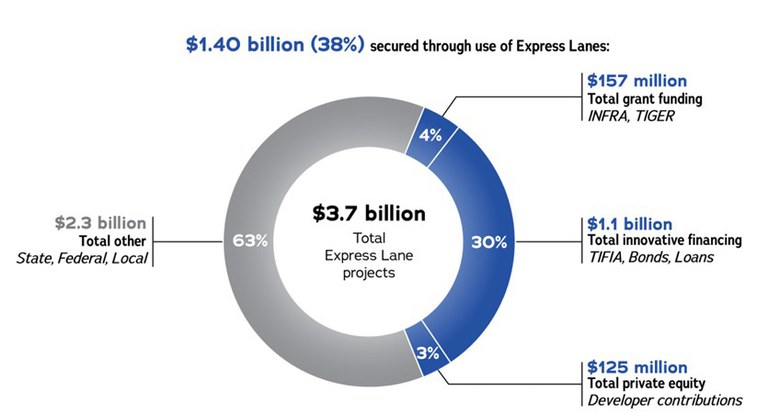
Through Express Lanes, CTIO has helped deliver more than $3 billion in projects in the last five years. In fact, without Express Lanes as a financing tool, Colorado would have had to find an additional $1.27 billion in funds to deliver the projects it delivered as of 2018.
The Need
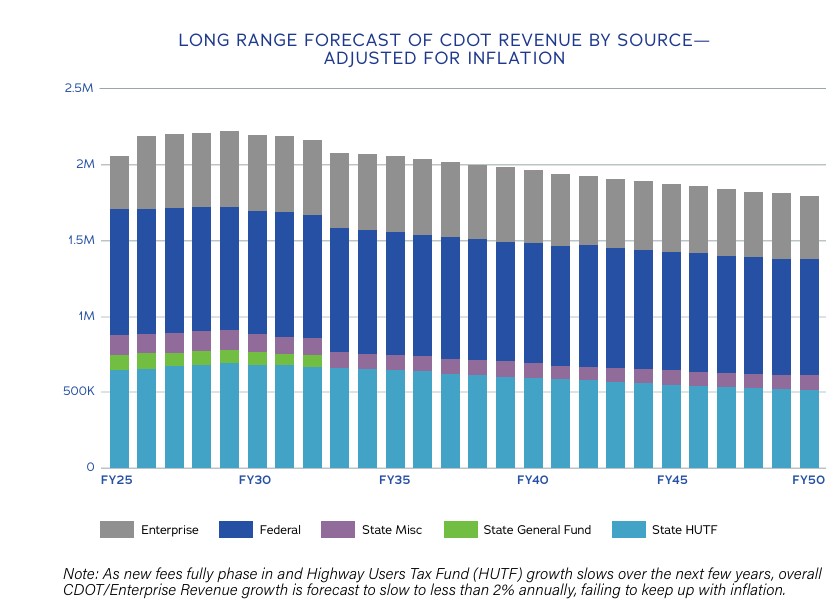
Colorado faces a critical challenge as rapid population growth intensifies pressure on an aging, severely congested highway infrastructure. The situation is made worse by slowing revenue growth (see the chart below) and the loss of purchasing power, severely limiting the state’s ability to maintain and expand the transportation system. Innovative, accelerated action is therefore required to find solutions that meet the state's future mobility needs.
CTIO's Value
Express Lanes have led to the accelerated delivery of almost $4 billion in highway projects throughout Colorado. If not for the tolling component of Express Lanes, these projects would have been either significantly delayed, delivered with a significantly reduced scope, or advanced at the expense of other CDOT projects throughout Colorado.
Aggressively seek out opportunities for innovative and efficient means of financing and delivering important surface transportation infrastructure projects in the state.
Impose tolls and other user fees, issue bonds, and enter into contracts with public and private entities to facilitate Public-Private Partnerships (P3s).
Act as an "enterprise" - for purposes of Section 20 of Article X of the State Constitution—as long as it retains the authority to issue revenue bonds, and receives less than 10 percent of its total revenues in grants from state and local governments.
Operate as a government-owned business within CDOT, but remain overseen by a separate board of directors that includes external stakeholders from four geographic regions appointed by Colorado's governor.
The CTIO Board of Directors consists of three members of the Transportation Commission (TC) and four members appointed by the Governor from each of the following geographic areas: (1) the planning area of the Denver Regional Council of Governments (DRCOG), (2) the planning area of the North Front Range Metropolitan Planning Organization (NFRMPO), (3) the planning area of the Pikes Peak Area Council of Governments, and (4) the I‑70 Mountain Corridor area.
The CTIO Board of Directors generally meets at 10:00 a.m. on the third Wednesday of every month at CDOT Headquarters (2829 W. Howard Place, Denver). These meetings are open to the public under the Colorado Open Meetings Law, and citizens are welcome to attend and participate. CTIO’s enabling statute requires that the Board meet at least eight times per year.
CTIO Board Meeting agendas, minutes, and documents are accessible on the CTIO Board section of the CTIO website.
|
Board Member |
Region |
Term Expiration |
|
Cecil Gutierrez, Chair |
Transportation Commission | At Commission's will |
|
Terry Hart |
Transportation Commission | At Commission's will |
|
Tricia Conanico |
NFRMPO Planning Area | October 2027 |
|
Laura Warren |
I-70 Mountain Corridor | October 2027 |
|
Shelly Cook |
Transportation Commission | At Commission's will |
|
Nellie Moran, Vice-Chair |
DRCOG Planning Area | October 2027 |
|
Gina Sacripanti |
Pikes Peak Area COG Planning Area | October 2027 |
- CTIO Unsolicited Proposal Policy (2023)
- CDOT and CTIO MOU (2021)
- P3 Management Manual (2020)
- Toll Rate Setting Policy (2023)
- CTIO Budget Process and Reporting Guidelines (2016)
- CTIO First Amended Transparency Policy relating to P3s (2015)
- CTIO Bylaws (2014)
- Procurement Guidelines (2011)
- Articles of Organization (2009)
Since 2014, Express Lanes have led to the accelerated delivery of over $3 billion in freeway projects throughout Colorado. If not for the tolling component of Express Lanes, these projects would have been either significantly delayed, delivered with a significantly reduced scope, or advanced at the expense of other CDOT projects throughout Colorado.
