
Cannabis in a can
A guide to weed drinks and what they mean for driving
Key takeaways:
- Drinkable cannabis products are rising in popularity, and they’re available to purchase in Colorado from dispensaries, liquor stores and online ads.
- There are product differences. THC drinks from dispensaries are cannabis-infused beverages. THC drinks from liquor stores or online stores are hemp-derived THC beverages. CBD drinks don’t cause a high, but double-check the label.
- If you see THC listed anywhere on the label, assume the drink can impair you and don’t drive after consuming it.
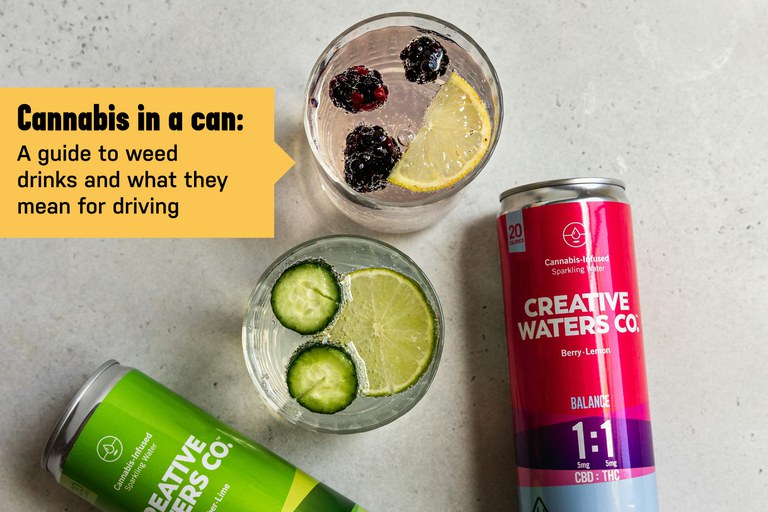 Walk into a grocery store or scroll social media, and you’ll see them everywhere: THC sodas, hemp seltzers, CBD mocktails, “Delta-8” drinks, tinctures, calming tonics, sleep blends, alcohol alternatives.
In just a few years, drinkable cannabis products have proliferated outside of licensed cannabis retail locations (dispensaries). They are appearing in more places than ever before — from liquor stores to gas stations, and are even available online. They’re often packaged in artsy cans, come in familiar flavors and are marketed as an alternative to alcohol or traditional marijuana.
But what’s inside those cans can vary quite a bit. The labels look similar, but the effects are not — which can play a huge role in your ability to drive safely.
We’ve broken it down for you to help make sense of all the different types of cannabis-infused drinks.
THC drinks sold in dispensaries
These are cannabis-infused beverages that contain Delta-9 THC (or Tetrahydrocannabinol, the compound that causes a high).
THC products sold in dispensaries are regulated under Colorado’s marijuana laws. You should not drive after drinking this type of beverage. Driving while impaired by cannabis is illegal and can result in a DUI, just like alcohol.
THC drinks sold in liquor stores
This is where many people get confused. THC made from cannabis can only be sold in licensed dispensaries. But THC made from hemp can be sold in low-dose servings in liquor stores, grocery stores and gas stations — at a maximum of 1.75 mg THC per serving, or can.
Even though they are “hemp-derived,” and “low dose,” they can still contain enough THC to impair your ability to drive — especially if you drink more than one.
For reference, 5 to 10 mg of THC is a common single serving in many cannabis edibles and can be enough to slow reaction time, impair coordination, affect judgment and alter perception. To your body, THC is THC. Whether it came from hemp or marijuana, it can impair driving.
Hemp-derived THC drinks sold online
These are often the drinks advertised on social media that say “Delta-8” or “hemp-derived Delta-9” and offer shipping. Like liquor store versions, these products contain THC extracted from hemp.
Delta-8 THC and Delta-9 THC are both intoxicating. Delta-8 is sometimes marketed as “lighter,” but it can still impair your ability to drive.
Many companies will only ship their products to states where hemp-derived THC products are currently allowed. Some states restrict or prohibit intoxicating hemp products such as Delta-8. In other states, regulations are still evolving.
In Colorado, hemp-derived products are regulated separately from marijuana products, and there are limits on how much hemp-derived THC can be included in products sold outside the dispensary system.**
It’s important to remember: “Hemp” does not mean “non-intoxicating.” The key factor is how much THC is in the drink and how it affects you. Check the label — if it lists THC in milligrams — whether Delta-8 or Delta-9 — assume it may affect your ability to drive.
CBD Drinks
CBD is different. These drinks do not cause a high. They typically don’t impair coordination or judgment. However, it’s important to check the label carefully. Some drinks marketed as “CBD” may also contain small amounts of THC. If it truly contains CBD only, it is not intoxicating. If it contains THC, impairment is possible and you should not drive.
Keep in mind that while it may be safe to drive after consuming CBD, as with any supplement or medication, on first use, you should consume it in a controlled environment to see how it affects you. CBD may have side effects on you, like drowsiness or fatigue, that should be evaluated before driving. To learn more about all the impairing and non-psychoactive cannabinoids, read this article.
How to tell what you’re getting
Here’s what to check before you drink, especially if you plan to drive later.
- Look for the word “THC” on the label. If you see THC listed anywhere on the label, assume it can impair you and don’t drive.
- Check the milligrams (mg) per serving and per container for an indication of potency. However, the impairing effects of THC are notoriously difficult to predict. And producers can struggle with inconsistency in product potency.
- Look for terms like Delta-8, Delta-9 or Delta-10. All are forms of THC and can impair driving. Also, be aware of illicit or unregulated synthetic cannabinoids, such as HHC, THCO and THCP.
- Keep an eye out for other impairing cannabinoids like CBN. Products are constantly evolving, so if there’s anything you don’t recognize, do your research.
- Read the ingredient panel. Don’t rely on words like “hemp,” “calm” or “social.” Check for actual ingredients and cannabinoid content.
When in doubt, don’t drive. If you feel different, you drive different.
Cannabis drinks may be new for some people, but safe driving isn’t. Whether it’s alcohol, marijuana or hemp-derived THC, the bottom line is the same: if something changes how you think, react or feel, it changes how you drive. Taking a few extra seconds to read the label and plan your ride home helps protect you, your passengers and everyone else on the road.
For more tips and information on cannabis and driving, visit CDOT’s Drugged Driving homepage.
**Under current Colorado law, intoxicating hemp products (including beverages) are split into two categories based on their THC content and ratios. Products allowed to be sold outside a licensed marijuana dispensary must meet the following requirements (SB23-271):
- Have no more than 1.75 mg of THC per serving.
- Have a ratio of at least 15:1 (CBD to THC).
- Products with a ratio less than 20:1 or containing more than 1.25 mg of THC cannot be sold to anyone under 21.
- Delta-8 THC and other chemically synthesized cannabinoids are strictly prohibited.
A new federal law set to take effect in November 2026 caps hemp products at 0.4 mg of THC per container. This will effectively ban almost all intoxicating hemp products currently legal in the Colorado market.
