
Colorado Boulevard Bus Rapid Transit Design
About the Project
The Colorado Department of Transportation (CDOT), in collaboration with the Regional Transportation District, the City and County of Denver, Arapahoe County, the City of Glendale, and the Denver Regional Council of Governments, is planning to improve travel on parts of Colorado Boulevard through implementing Bus Rapid Transit (BRT) service between I-70 and the Southmoor transit station south of Hampden Avenue. BRT provides high-quality transit service by combining the capacity and efficiency of light rail with the flexibility, cost and simplicity of bus service. This project is being developed to comply with the National Environmental Policy Act (NEPA), a law that requires agencies to assess the environmental impacts of actions and decisions funded by the federal government.
As of 2026, the project is currently in the alternatives analysis phase, which focuses on identifying potential BRT options that will help address the corridor’s mobility and safety challenges. Building on the 2024 Colorado Boulevard Corridor Plan, specific alternatives will be presented for public comment in 2026. Based on this feedback, one alternative, called the locally preferred alternative or LPA, will be recommended for implementation. Potential impacts from the recommended alternative will then be evaluated in detail over the following months by the project partners and the Federal Transit Administration (FTA). The project will then initiate the design phase with the intent to start preliminary design in 2027. A construction start date has yet to be determined.
Schedule & Important Dates
- 2024 to 2026: Review existing conditions, develop draft alternatives and gather stakeholder feedback.
- 2027: Identify the preferred alternative, gather stakeholder feedback, prepare design documentation and determine NEPA Class of Action.
- 2028: Continue stakeholder outreach, complete 30% design and submit NEPA documentation.
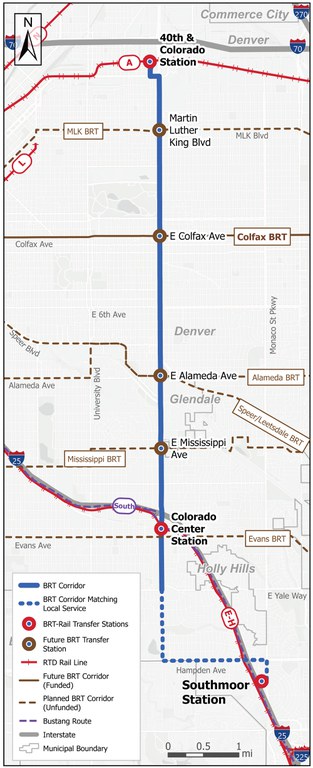
Colorado Boulevard is a state highway and commercial corridor connecting people to jobs, schools, health care, shopping, restaurants, recreational destinations, and many other key destinations. Colorado Boulevard is the only major arterial on the city's east side that moves people between the northern and southern boundaries of Denver and connects to Glendale. It is a backbone of activity for both Denver and Glendale, but can be a difficult street to travel by any means other than a car.
Over the last century, Colorado Boulevard has evolved to prioritize ever-increasing levels of vehicular traffic. This has resulted in a busy and congested corridor that doesn’t work well for all road users. Colorado Boulevard is a part of Denver's high-injury network for traffic-related deaths and serious injuries
The Colorado Boulevard BRT Project will help achieve the following goals:
- Increased capacity to efficiently move people along Colorado Boulevard
- Fast, frequent, and reliable public transit
- New enhanced bus stations with weather protection, real-time information displays, security cameras, ticket machines, and other features
- Level boarding to improve accessibility for transit riders
- Improved safety for all road users
- New and improved sidewalks along the corridor
Colorado Boulevard BRT is an important component of the long-term regional vision to make transit fast, frequent, and reliable across the Denver metropolitan region. It is one of 11 designated bus rapid transit corridors in the 2050 Regional Transportation Plan. BRT lines will complement existing rail lines and local bus service and make it easier to travel the Denver region and beyond without a car.
