
Information for Bicyclists
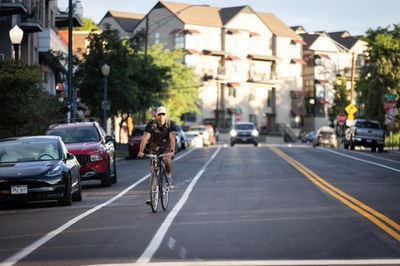
Colorado is one of the most bicycle-heavy states in the U.S., with the second-highest rate of commuter bicyclists.
Three Colorado cities — Denver, Fort Collins and Boulder — fall in the top 20 nationwide for the highest number of people who use a bike as their main mode of transportation to work.
Approximately three-quarters of all bicyclist fatalities occur in urban areas such as Denver, El Paso and Boulder counties. Fatalities and injuries can be prevented if motorists and bicyclists heed safety laws and follow safety practices.
Know the Laws
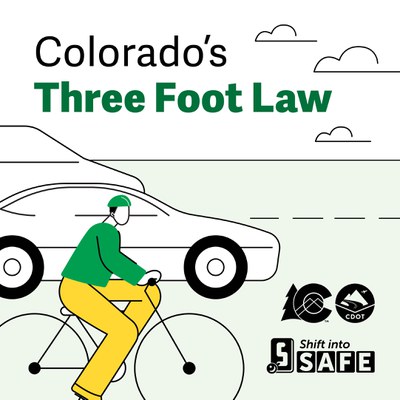 Colorado’s Three Foot Law requires drivers and motorcyclists to give bicyclists and e-bike riders at least three feet of space when passing.
If there is not enough room, or oncoming traffic prevents a safe three-foot buffer, drivers must slow down and remain behind the bicyclists until it is safe to pass.
CDOT reminds all motorists that they must exercise extreme caution and maintain a safe distance when overtaking all vulnerable road users who lack the same protections as those inside a vehicle.
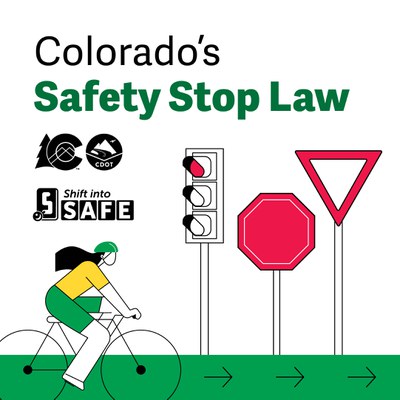 In 2022, Colorado passed the Safety Stop Law, allowing bicyclists to treat stop signs as yield signs and red lights as stop signs. The law applies to anyone 15 years of age or older operating a bicycle or low-speed conveyance, including electric scooters, e-bikes, human powered toy vehicles (like skateboards), and electric personal assistance mobility devices (EPAMDs). Please note, those under 15 years of age can only do so if they are accompanied by a parent or legal guardian.
This law is intended to reduce injuries and fatal crashes resulting from collisions at controlled intersections and has the following conditions:
- When approaching a stop sign, bicyclists must slow down and stop before entering the intersection, if necessary for safety. If the stop is not required for safety, riders must slow to a reasonable speed of 10 mph or less and yield the right-of-way to any traffic or pedestrians in or approaching the intersection.
- When approaching a red light, bicyclists must stop before the intersection and yield to all traffic and pedestrians. After yielding, bicyclists can only proceed in the same direction through the intersection or make a right-hand turn if the intersection is clear. If there’s an oncoming vehicle turning or preparing to turn left in front of them, bicyclists shall not proceed.
- Bicyclists may make a left-hand turn at a red light only if turning onto a one-way street and only after coming to a stop and yielding to all traffic and pedestrians.
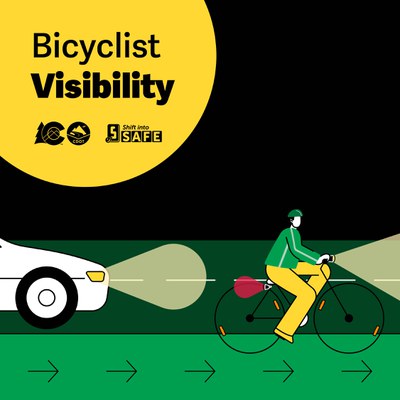 To ensure visibility in low-light conditions, Colorado law requires bicycles, e-bikes, electric scooters and other EPAMDs to display lighting and reflective equipment between sunset and sunrise, and at any other time when, due to insufficient light or unfavorable atmospheric conditions. By law, these conveyances must be equipped with the following:
- Front light: Lamp on the front emitting a white light visible from a distance of at least 500 feet to the front.
- Rear reflector: State-approved red reflector on the rear visible from 600 feet when directly in front of a motor vehicle’s low-beam headlights.
- Side visibility: Reflective material visible from both sides for 600 feet when exposed to low-beam headlights, or in place of reflective material, a lighted lamp visible from a distance of at least 500 feet from both sides.
For more information on bicycle, electric scooter, and personal mobility device equipment laws, please see C.R.S. § 42-4-221. For more information on e-bikes, please see GoSafeGoFar.com.
While some laws protecting bicyclists extend these protections to electric scooters, toy vehicles, EPAMDs and other low-speed conveyances, riders should recognize that they can carry inherently more safety risks — due to traveling at higher speeds — and face varying local restrictions regarding road or sidewalk usage. CDOT strongly urges everyone to wear protective equipment, like helmets, and check their specific city or county ordinances to ensure compliance with local regulations.
For more information on Colorado laws regarding the operation of bicycles, electric scooters, and other human-powered vehicles, please see Colorado Revised Statutes 42-4-1412.
Safety Tips
Safety Tips for Drivers around Bicyclists
- Remember that bicyclists have the same rights and responsibilities as passenger vehicles, including the right to use the road.
- Yield to bicyclists as you would motorists and do not underestimate their speed. This will help avoid turning in front of a bicyclist traveling on the road or sidewalk, often at an intersection or driveway.
- Always check your surroundings for bicyclists while in parking lots, at stop signs, when backing up, or when parking.
- Drivers turning right on red should look to the right and behind to avoid hitting a bicyclist approaching from the right rear.
- Obey the speed limit, reduce speed for road conditions and drive defensively to avoid a crash with a bicyclist.
- When passing a bicyclist, give them at least three feet of space. Pass as you would any other vehicle — when it’s safe to move over into an adjacent lane.
Safety Tips for Bicyclists
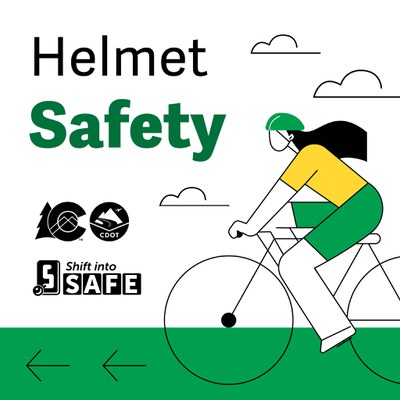
- Always wear a properly fitting helmet and protective gear while riding.
- Check your brakes, tire pressure, gears, chains and hardware for wear and tear, rust or other signs of damage that can cause malfunction.
- Ride as far right as possible on a road with the flow of traffic.
- Watch for and avoid motorists’ blind spots.
- Use bike lanes and paved right-hand shoulders whenever possible.
- When entering intersections, yield to any pedestrians and stop before crosswalks.
- Avoid alcohol and drugs when riding; they impair your abilities and your judgment.
- At night, use lights and/or reflective clothing to alert other drivers and pedestrians of your presence.
Resources
CDOT Resources
- Statewide Bicycling Manual
- E-Bike Safety Campaign
- Tips for overcoming excuses
- Tips for improving biking efficiency
Other Resources and Safety Information
- Alliance for Biking and Walking
- Association of Pedestrian and Bicycle Professionals
- Bicycle Colorado
- Bicycle Safer Journey: Skills for Safe Bicycling for Ages 5 to 18
- Bicycle Safety for Kids
- Pedestrian and Bicycle Information Center
- Complete Streets
- The League of American Bicyclists
- The League of American Bicyclists Safety Videos
- NHTSA Bicycle Safety Tips for Adults
- Rails to Trails Conservancy
